SecurityX occupies an unusual position in the cybersecurity certification market. It targets professionals who have already moved beyond foundational security work, yet it asks a deeper question: can technical experience demonstrate architectural judgment?
That distinction matters because modern security roles are increasingly defined by decisions rather than tools. A security engineer may know how to deploy controls, but a security architect must determine which controls create acceptable risk reduction within technical, operational, and business constraints.
The challenge in evaluating SecurityX is that traditional certification measurements are often incomplete. Recognition, salary impact, and job postings tell only part of the story. The more important question is whether CAS-005 validates the reasoning patterns required in complex enterprise environments.
Understanding What SecurityX Actually Measures
A common assumption about advanced cybersecurity certifications is that difficulty comes from the amount of information covered. That explanation misses the larger shift happening in security careers.
The challenge with CAS-005 is less about remembering additional technologies and more about evaluating security decisions when several answers appear technically reasonable.
Security professionals rarely work with perfect conditions. Enterprise environments contain legacy systems, regulatory constraints, limited budgets, operational dependencies, and competing priorities. A technically stronger solution may not always be the most appropriate business decision.
For example, a security architect evaluating access controls is not only asking whether stronger authentication improves security. The real questions include:
- How will existing applications handle the change?
- Which users require different access models?
- What operational risks appear during migration?
- Are temporary compensating controls acceptable?
This difference separates implementation knowledge from architectural judgment.
CAS-005 is valuable because it reflects a professional reality: advanced security work is often about choosing between imperfect options.
A firewall engineer may understand how segmentation works. A security architect must determine whether segmentation is the correct investment compared with identity improvements, application security changes, or monitoring enhancements.
The distinction is subtle but important.
SecurityX is not simply measuring whether someone knows security concepts. It is evaluating whether that knowledge can be applied across interconnected environments.
Where SecurityX Fits in the Certification Landscape
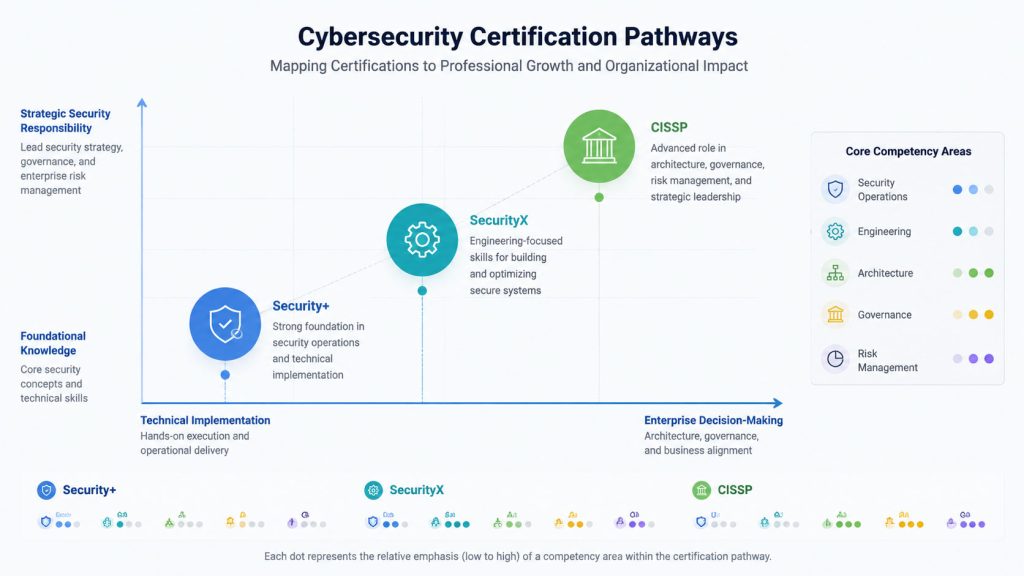
Security certifications are often placed on a simple ladder:
- Security+ for foundational knowledge
- SecurityX for advanced technical capability
- CISSP for security leadership
That model is convenient, but it does not fully describe how professionals actually use these certifications.
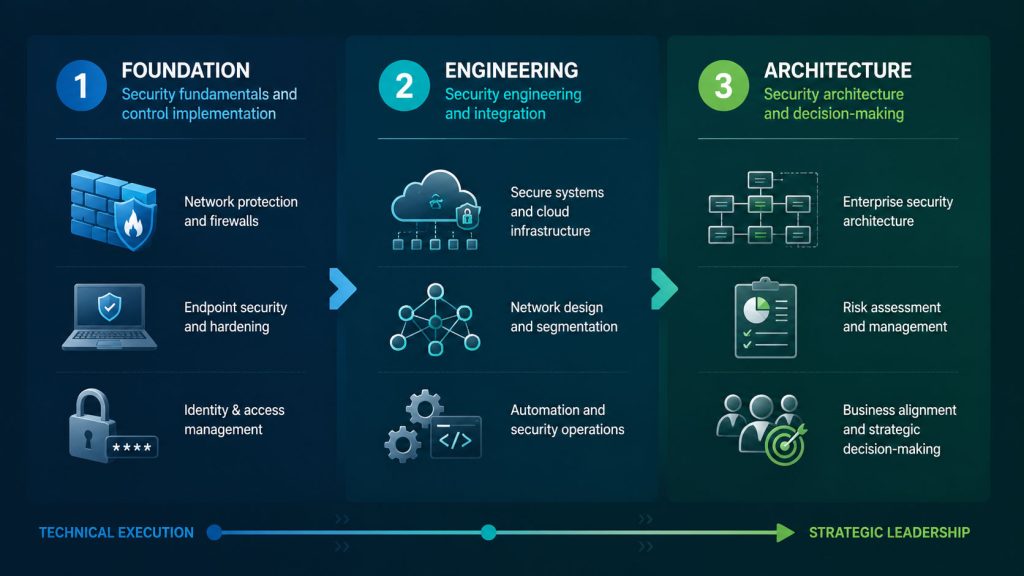
SecurityX is not simply the “next level” after Security+. The transition is not about learning more security terms. It is about moving from understanding controls to evaluating how controls should be designed, prioritized, and implemented.
Security+ provides professionals with the language of cybersecurity:
- threats
- vulnerabilities
- controls
- risk concepts
- security operations
SecurityX assumes that foundation already exists and focuses on what happens when security decisions become more complex.
The difference is responsibility.
A Security+ professional may need to understand why least privilege matters.
A SecurityX-level professional may need to decide how least privilege should work across thousands of identities, cloud platforms, legacy applications, and business processes.
That distinction explains why experience matters before attempting CAS-005. A professional who has spent years operating security tools may still need broader exposure to architecture, governance, and risk decisions.
The strongest candidates are usually not those who have collected the most certifications. They are professionals who have started making security decisions that affect systems, teams, and organizations.
SecurityX vs Security+
The comparison between SecurityX and Security+ is often presented as a difficulty comparison. That is incomplete.
The more meaningful difference is the type of professional thinking each certification represents.
Security+ validates foundational cybersecurity knowledge. It helps professionals understand the purpose of security controls and the role those controls play within an organization.
SecurityX examines what happens after that foundation exists.
The question changes from:
“Do you understand this security concept?”
to:
“Given these competing requirements, what security decision creates the best outcome?”
That difference appears clearly in areas such as identity management, cloud security, and risk analysis.
A Security+ candidate may need to understand the purpose of multi-factor authentication.
A SecurityX candidate may need to evaluate whether an organization should prioritize identity modernization, network segmentation, application redesign, or additional monitoring.
All of those options may improve security. The challenge is determining which one creates the greatest reduction in risk under real-world constraints.
This is also why SecurityX is not automatically the correct next step for every Security+ holder.
Some professionals may gain more immediate value from developing:
- cloud engineering experience
- security operations skills
- threat analysis capability
- automation skills
- infrastructure expertise
The deciding factor is not certification sequence. It is whether the professional is moving toward security decision-making.
SecurityX vs CISSP: Different Perspectives, Not Opposing Paths
The comparison between SecurityX and CISSP is often simplified into one sentence:
SecurityX is technical. CISSP is managerial.
That description creates an inaccurate distinction.
Both certifications include technical and governance concepts. The difference is the perspective from which security problems are approached.
SecurityX aligns more closely with professionals evaluating security solutions, architecture decisions, and technical implementation strategies.
CISSP places stronger emphasis on managing security programs, organizational risk, policy development, and communication with business leadership.
A security architect deciding how to structure identity controls in a hybrid cloud environment may find SecurityX closely aligned with the technical decision process.
A security leader responsible for security governance across multiple departments may find CISSP more directly connected to their responsibilities.
Neither certification replaces the other.
The better question is not which certification is more advanced.
The better question is:
What type of security decisions does your career require you to make?
A professional designing systems may prioritize different knowledge than a professional managing enterprise security strategy.
Who Gains the Most Career Value From SecurityX?
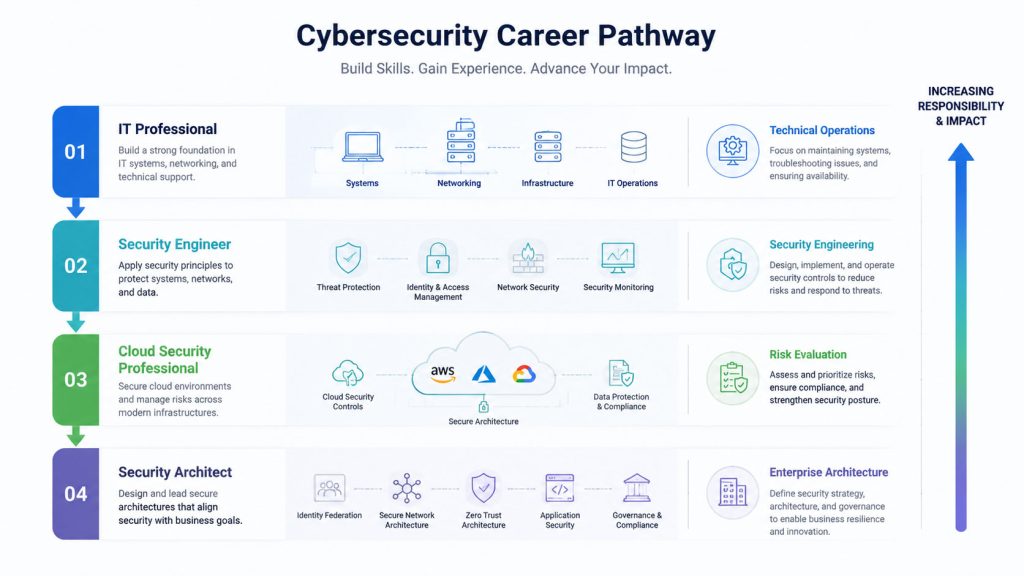
The phrase “experienced cybersecurity professional” covers too many different roles. SecurityX creates different value depending on the type of work someone performs.
Security Engineers
Security engineers are among the professionals most likely to benefit from CAS-005, but the value depends on whether their role involves architecture decisions.
An engineer focused entirely on deploying and maintaining specific technologies may receive faster returns from specialized technical training.
For example, someone working primarily with endpoint tools, firewall administration, or a single cloud platform may benefit from deeper product expertise.
The value of SecurityX increases when the role expands beyond operation.
Modern security engineers increasingly evaluate questions such as:
- Should access controls be redesigned through identity systems or network segmentation?
- Should a vulnerability receive immediate remediation or risk-based treatment?
- Should an organization adopt a new platform or improve existing controls?
These decisions require understanding relationships between security domains.
That is where CAS-005 aligns with real engineering responsibilities.
Cloud Security Professionals
Cloud security has increased the importance of architectural thinking, but not because cloud platforms are simply more complicated.
The larger change is that cloud environments expose weaknesses in security design.
A cloud security problem may appear to be a configuration issue while the real problem is:
- unclear ownership
- weak identity processes
- poor access governance
- insufficient monitoring
- incomplete architecture planning
A professional focused only on cloud services may solve the immediate technical problem.
A security architect must understand why that problem existed and how to prevent similar failures across the environment.
This broader perspective is where SecurityX becomes relevant for cloud-focused professionals.
Security Architects
Security architects represent the clearest alignment with SecurityX because architecture work requires balancing competing priorities.
Enterprise security decisions rarely involve choosing between secure and insecure options.
More often, they involve choosing between several imperfect solutions.
An architect may need to decide:
- whether a legacy system should be isolated or replaced
- whether additional controls justify operational complexity
- whether cloud migration risks require redesign
- whether security investments match business priorities
SecurityX does not create architectural experience by itself.
However, for professionals already moving toward architecture responsibilities, it can provide a structured framework for evaluating the decisions they increasingly encounter.
Risk Management, Zero Trust, and Enterprise Architecture: Where SecurityX Becomes Practical
SecurityX discussions often separate topics such as risk management, Zero Trust, and architecture into different categories. In enterprise environments, these areas are connected by one central challenge:
Security professionals must decide where security investment creates the greatest reduction in organizational risk.
That sounds straightforward, but real environments rarely provide simple answers.
A stronger security control can introduce new operational challenges. A stricter access model may improve security while creating workflow problems. A new security platform may reduce one risk while increasing complexity elsewhere.
The role of an advanced security professional is not to eliminate every possible risk. That is rarely achievable. The responsibility is to evaluate which risks require immediate action, which risks can be managed, and which investments create meaningful improvement.
Risk Management Is More Than Identifying Threats
One of the common misunderstandings about enterprise security is that the most technically severe issue should always receive the highest priority.
In practice, risk decisions depend on context.
A vulnerability affecting a low-value internal application may receive less attention than an identity weakness affecting thousands of users. A system with outdated software may represent less immediate risk than a poorly designed access process controlling sensitive information.
The technical issue matters, but the surrounding environment determines the impact.
This is where advanced security roles differ from purely operational positions.
A security analyst may identify vulnerabilities.
A security architect must determine:
- which vulnerabilities represent meaningful business risk
- which controls reduce exposure effectively
- which solutions create unacceptable operational costs
CAS-005 aligns with this type of reasoning because enterprise security decisions are rarely isolated technical problems.
Zero Trust: Architecture Decision, Not Product Selection
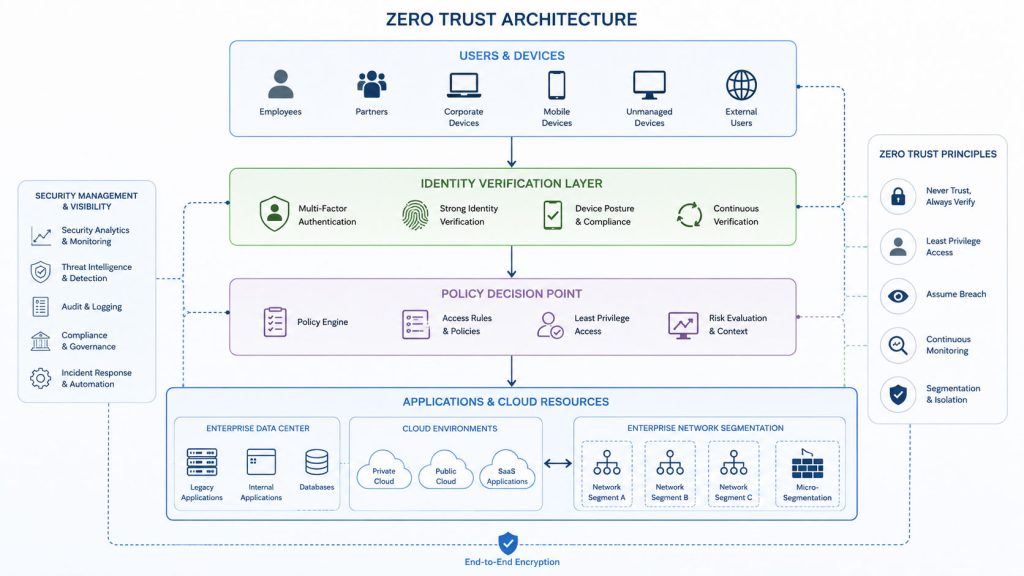
Zero Trust has become one of the most discussed concepts in modern security, but discussions often become focused on tools.
Organizations may purchase identity platforms, security gateways, or monitoring solutions while missing the architectural decisions required for successful implementation.
Zero Trust depends on questions such as:
- Who should access a resource?
- How is identity verified?
- How are permissions reviewed over time?
- Which applications require different security models?
- How should trust decisions change based on risk?
The difficult part is not understanding the definition of Zero Trust.
The difficult part is applying the model inside environments with existing applications, business dependencies, and technical limitations.
For CAS-005 candidates, understanding Zero Trust means understanding implementation challenges, not only knowing terminology.
The strongest security professionals recognize that architecture decisions often determine whether security strategies succeed or fail.
Study Strategy: Preparing for CAS-005 Through Decision-Making
Preparation for CAS-005 requires a different mindset from certifications focused mainly on recognition of concepts.
The challenge is not only learning more information.
It is developing the ability to evaluate why one decision is better than another.
Study the Relationships Between Domains
A common mistake in advanced certification preparation is treating exam topics as separate categories.
Enterprise security does not work that way.
IAM decisions influence:
- cloud security
- compliance
- application design
- operational workflows
Threat modeling connects with:
- business impact
- architecture choices
- risk prioritization
Incident response connects with:
- monitoring strategy
- governance processes
- recovery planning
The strongest candidates understand these relationships because real security problems rarely belong to one domain.
Evaluate Practice Questions Differently
Practice questions are useful, but their value depends on how they are reviewed.
Memorizing why an answer is correct creates limited improvement.
A stronger approach is examining the decision process:
- What risk is the scenario prioritizing?
- Which business requirement influences the choice?
- Why are alternative answers weaker?
- Under what circumstances would another solution become appropriate?
This approach develops the reasoning pattern required for scenario-based questions.
When evaluating preparation resources, candidates should focus less on the number of questions provided and more on whether explanations demonstrate realistic security decision-making.
Resources such as CAS-005 Exam Preparation Resources may be considered as part of a broader preparation plan, but practice materials should be judged by scenario quality, explanation depth, and alignment with official objectives rather than question volume alone.
When SecurityX May Not Be the Best Investment
Not every experienced IT professional will receive the same value from CAS-005.
A common assumption is that more experience automatically means an advanced certification creates more benefit.
That is not always true.
A professional who specializes deeply in one technical area may receive greater career returns from expanding into adjacent skills.
Examples:
A network engineer may gain more immediate value from cloud security experience.
A cloud administrator may benefit from stronger identity and automation skills.
A security analyst may need more hands-on incident response experience.
SecurityX becomes more valuable when the professional is already moving toward broader security responsibility.
The question is not:
“Is SecurityX a good certification?”
The better question is:
“Does SecurityX measure the type of security work I want to perform?”
Measuring the Career ROI of SecurityX
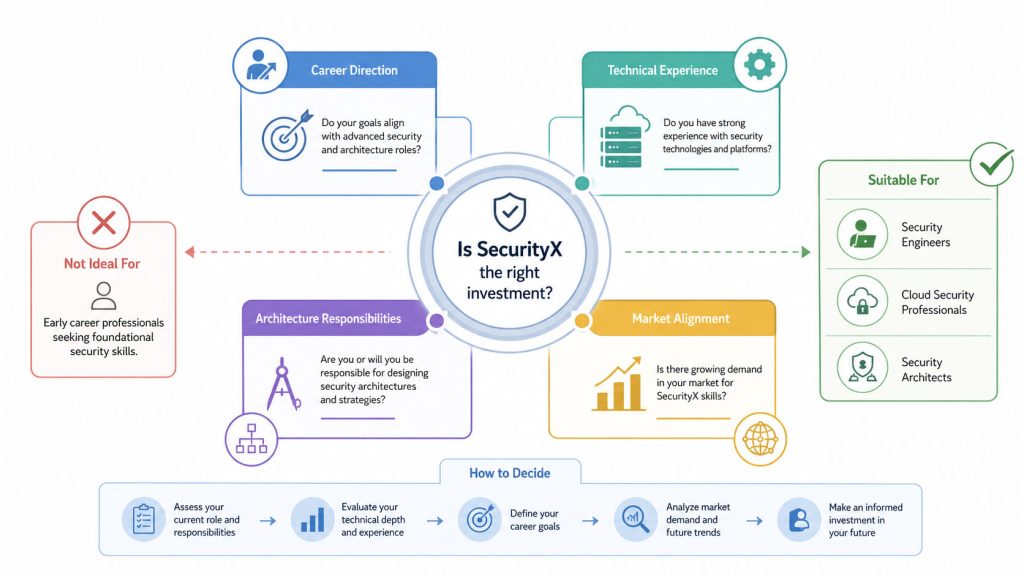
The value of SecurityX is difficult to measure only through salary increases.
Advanced certifications rarely create career movement by themselves.
Their value usually appears through several indirect benefits:
- stronger credibility in technical discussions
- improved ability to communicate security decisions
- better alignment with architecture responsibilities
- stronger foundation for senior security roles
For example, a security engineer participating in architecture reviews may find that CAS-005 concepts provide a useful framework for explaining security decisions to technical teams and leadership.
However, expectations should remain realistic.
Employers evaluate combinations of:
- technical ability
- project experience
- communication skills
- problem-solving capability
- certifications
SecurityX can strengthen an existing professional profile, but it cannot replace evidence that someone can design, evaluate, and operate security solutions.
The Long-Term Value Question: Is SecurityX Worth It in 2026?
The strongest argument for SecurityX is not that it guarantees career advancement.
No certification can make that promise.
Its value comes from the type of thinking it encourages.
Security professionals are increasingly required to move beyond operating individual controls and toward understanding how security decisions affect entire systems.
That shift is visible across:
- hybrid cloud environments
- identity-focused security models
- Zero Trust adoption
- security architecture programs
- enterprise risk management
For professionals already working near those responsibilities, SecurityX can provide meaningful value.
For professionals still building foundational technical experience, other investments may produce faster results.
The decision depends on career direction.
SecurityX is most useful for professionals who are transitioning from:
“how do I implement this security control?”
toward:
“which security approach creates the best outcome for this organization?”
That distinction is what separates advanced security engineering from basic security administration.
Conclusion: A Decision Framework, Not a Certification Recommendation
SecurityX is not difficult to evaluate because of exam difficulty alone.
The harder question is whether its focus matches the professional responsibilities someone wants to develop.
For security engineers moving toward architecture, cloud professionals dealing with enterprise security decisions, and technical leaders evaluating risk across complex environments, CAS-005 aligns with important industry trends.
For professionals seeking their first security role, deeper specialization, or immediate operational skills, other certifications or practical projects may provide greater returns.
The most accurate way to view SecurityX is not as a universal career accelerator.
It is a certification designed for a specific transition:
from implementing security solutions to making security decisions.
That transition is valuable, but only when it matches the direction of a professional’s career.
Editorial Notes
This article is designed as an editorial analysis rather than a traditional certification study guide. The conclusions presented here are based on a comparative review of the official CompTIA SecurityX (CAS-005) exam objectives, certification updates, publicly available cybersecurity career trends, and technical discussions within the professional security community.
Wherever multiple viewpoints exist, this article favors evidence-based reasoning over absolute conclusions. Its purpose is to help experienced IT professionals evaluate the long-term value of SecurityX from both a technical and career perspective—not simply prepare for the exam.
Research Methodology
This article was developed through a structured editorial review process that included:
- Official CompTIA SecurityX (CAS-005) exam objectives and certification updates
- CompTIA blog articles and published certification resources
- Current cybersecurity job market observations
- Community discussions from experienced certification candidates and security professionals
- Industry documentation covering enterprise security architecture, governance, risk management, Zero Trust, and cloud security
- Comparative analysis with related certifications, including Security+, CySA+, and CISSP
Evidence Summary
| Editorial Conclusion | Supporting Evidence |
|---|---|
| SecurityX evaluates architectural decision-making rather than procedural execution. | CompTIA CAS-005 Exam Objectives |
| Business context frequently influences the best technical answer. | Official exam objective scenarios and enterprise security documentation |
| Enterprise-level security architecture is a recurring theme throughout the certification. | CompTIA SecurityX Blueprint |
| SecurityX aligns most closely with experienced cybersecurity roles. | Current cybersecurity job market observations |
| Community discussions consistently emphasize reasoning over memorization. | Reddit discussions and technical community feedback |
Official References
- CompTIA SecurityX (CAS-005) Exam Objectives
- CompTIA SecurityX Certification Page
- CompTIA Blog
- NIST Cybersecurity Framework (CSF)
- NIST Zero Trust Architecture (SP 800-207)
- Microsoft Learn Security Documentation
- AWS Security Documentation
- Google Cloud Security Best Practices
Editorial Perspective
Unlike many certification articles that focus primarily on passing the exam, this analysis approaches SecurityX as a long-term professional investment. Rather than repeating the published objectives, the goal is to examine what the certification actually measures, how it aligns with enterprise cybersecurity roles, and where its value fits within today’s evolving security landscape.