CompTIA SecAI+ CY0-001 Certification Guide: Is This the Right AI Security Credential for Your Cybersecurity Career?

CompTIA SecAI+ CY0-001 Certification Guide

Security professionals are starting to face a new responsibility: protecting systems that can interpret instructions, retrieve data, generate output, and trigger actions. CompTIA SecAI+ CY0-001 exists because traditional cybersecurity knowledge still matters—but AI systems introduce risks that do not fit neatly into older security models.

Why Cybersecurity Professionals Are Paying Attention to SecAI+

The reason AI security has become a distinct area of cybersecurity is practical. Organizations are connecting generative AI, copilots, retrieval systems, agents, and machine learning services to internal data and business processes. Once an AI system can access information or interact with other tools, the security discussion extends beyond the familiar questions of authentication, authorization, and network exposure.

OWASP’s guidance for LLM and generative AI applications highlights risks such as prompt injection, sensitive information disclosure, supply-chain vulnerabilities, data and model poisoning, improper output handling, and excessive agency. MITRE ATLAS similarly documents adversarial tactics and techniques involving AI-enabled systems. These frameworks show that AI does not replace established cybersecurity principles; it creates new places where those principles must be applied.

For a security professional, the practical change may look like this: instead of reviewing only who can access an application, you may need to understand what information an AI model can retrieve, what instructions can influence its behavior, which tools it can call, and what permissions those tools carry.

That is the professional context behind the SecAI+ certification. It is designed around the growing overlap between cybersecurity practice and AI deployment rather than around AI development alone.

The new challenge is applying familiar security principles to unfamiliar behavior

Take least privilege. The principle is well established. But an AI agent connected to enterprise systems creates additional questions: Does it need permission to read data, modify it, or both? Can it independently trigger actions? What happens if malicious content influences the model’s instructions?

OWASP identifies excessive agency as a risk when an AI system has unnecessary functionality, permissions, or autonomy that can lead to harmful actions. The underlying security principle is familiar; the system behavior is not.

This is why AI security certification is becoming a meaningful category. Security teams increasingly need professionals who can connect AI concepts with threat modeling, access controls, data protection, monitoring, governance, and risk decisions.

What CompTIA SecAI+ CY0-001 Actually Tests

The official CompTIA SecAI+ certification is structured around four connected areas: AI concepts relevant to cybersecurity, securing AI systems, AI-assisted security operations, and AI governance, risk, and compliance.

The CY0-001 exam is more useful to understand as a map of professional responsibilities than as a list of topics to memorize.

1. Understanding AI systems well enough to secure them

You do not need to become a data scientist to work in AI security. You do, however, need enough technical understanding to recognize where risk enters the system.

That includes concepts associated with models, training, inference, prompts, retrieval, data sources, and AI-enabled applications. The security value comes from understanding how those components interact.

For example, a security professional reviewing a retrieval-augmented generation system needs to think beyond the model itself. Questions may include:

  • Where does retrieved data come from?
  • Who controls access to that data?
  • Can untrusted content influence the system?
  • What information can appear in generated output?
  • How are the surrounding APIs and infrastructure secured?

This is where the certification moves beyond general AI awareness.

2. Securing AI systems

This area represents the largest shift from conventional certification paths. The challenge is not simply securing an application that happens to use AI. Professionals must consider models, data pipelines, prompts, AI interfaces, access controls, connected tools, and third-party dependencies.

The threat landscape described by OWASP and MITRE ATLAS provides useful context. Prompt injection, data poisoning, model manipulation, insecure AI supply chains, and excessive permissions all require security professionals to think about attack paths that may not appear in traditional application architectures.

3. Using AI in security operations

SecAI+ also recognizes that security teams are increasingly using AI themselves.

AI-assisted security can support activities such as:

  • threat analysis
  • anomaly detection
  • vulnerability assessment
  • incident investigation
  • security automation
  • intelligence analysis

The security professional still needs to evaluate the output. An AI-generated assessment is not automatically reliable simply because it was produced quickly. Security decisions require validation, context, and an understanding of the limitations of the underlying system.

4. Governance, risk, and compliance

This is one of the areas that separates AI security from a purely technical specialization.

The NIST AI Risk Management Framework provides a framework for helping organizations manage AI risks and incorporate trustworthiness considerations across the AI lifecycle. For security professionals, governance increasingly intersects with practical technical questions involving sensitive data, third-party models, human oversight, acceptable system autonomy, and organizational accountability.

In other words, CompTIA SecAI+ CY0-001 is not just about identifying attacks against AI. It is about understanding how security decisions fit into the larger process of deploying and managing AI responsibly.

Is SecAI+ Worth It for Your Cybersecurity Career?

The answer depends less on the certification itself than on the direction of your work.

A new credential does not automatically create career value. Certifications become useful when they strengthen a capability that is relevant to your current responsibilities or the roles you are realistically moving toward.

SecAI+ is particularly relevant if you are already encountering AI through your work. That might include reviewing AI-enabled applications, supporting cloud-hosted AI services, assessing data exposure, working with AI-assisted security tools, or participating in governance discussions around enterprise AI adoption.

It may also make sense if you already have a solid security foundation and want to develop a more defined understanding of AI-specific risks.

The professional value is less clear if your immediate knowledge gap is somewhere more fundamental. A security professional with limited understanding of networking, identity, access control, incident response, or core threat concepts may benefit more from strengthening those areas first.

SecAI+ is likely to fit professionals who:

  • Already work in cybersecurity, cloud security, security operations, or IT security.
  • Expect AI systems to become part of their technical environment.
  • Need to assess AI-related threats and controls.
  • Want a structured introduction to AI security rather than learning through disconnected vendor documentation.
  • Are moving toward responsibilities involving AI governance or security architecture.

Another path may make more sense if you:

  • Still need foundational cybersecurity knowledge.
  • Need stronger networking fundamentals.
  • Are primarily focused on SOC analysis, detection, or incident response without an immediate AI security requirement.
  • Are pursuing a deeper specialization in penetration testing, cloud architecture, malware analysis, or another technical discipline.

The key distinction is simple: SecAI+ is a specialization, not a universal next step.

SecAI+ vs Security+ vs CySA+: Choosing the Right Path

Security certifications are often compared as though they form a single ladder. In practice, they solve different professional problems.

CertificationPrimary focusWho it fitsCareer purpose
Security+Core cybersecurity knowledgeIT and security professionals building or formalizing a foundationEstablish broad security competence
CySA+Security analysis and defensive operationsSOC analysts and security professionals focused on detection and responseDeepen operational cybersecurity skills
SecAI+AI security, AI-assisted security, and AI governanceProfessionals working around AI-enabled systemsDevelop AI security specialization

Security+ answers the broad question: Do you understand the essential principles of cybersecurity?

CySA+ moves further into security analysis, detection, vulnerability management, and defensive operations.

SecAI+ addresses a different question: Can you apply cybersecurity principles to AI systems and understand the risks created when models, data, prompts, agents, and automated actions become part of the environment?

For someone already holding Security+, SecAI+ can be a logical next step when AI security is relevant to the work ahead. It is not automatically a replacement for CySA+, and it does not remove the need for advanced security experience.

Professionals considering broader advanced responsibilities may also look at SecurityX, while Network+ remains relevant for professionals who need stronger infrastructure and networking fundamentals.

The right path depends on the capability you need to develop—not on which certification happens to be newest.

How Difficult Is CY0-001?

CY0-001 is likely to feel more challenging for candidates who approach it as an AI vocabulary test.

The difficult part is the intersection of domains. You need to understand enough about AI systems to recognize their behavior, enough about cybersecurity to identify the associated risks, and enough about governance to understand how technical decisions affect organizational exposure.

CompTIA’s recommended experience for SecAI+ reflects this. The certification is aimed at professionals with an existing IT and cybersecurity background rather than individuals starting from zero. The official exam objectives recommend roughly three to four years of IT experience and around two years of hands-on cybersecurity experience.

A candidate with practical experience in access control, threat modeling, cloud services, security monitoring, or application security may find it easier to connect AI concepts with existing knowledge.

The challenge is usually not remembering that prompt injection exists. The challenge is recognizing what happens after the attack and selecting the security control that addresses the actual risk.

For example, if an AI system can access internal documents and connected business tools, you need to understand the relationship between:

AI behavior → attack path → permissions → security control → residual risk

That type of reasoning is more useful than memorizing definitions in isolation.

How to Prepare for SecAI+ Effectively

A strong SecAI+ study guide should help you connect concepts rather than simply accumulate terminology.

Start with the official CY0-001 certification information and objectives. Before choosing study material, identify which of the four major areas is already familiar and where your knowledge is thinner.

A practical preparation approach can follow four steps.

1. Build the AI security context

Understand the components of AI systems that create security decisions.

Focus on:

  • models and inference
  • training and data sources
  • prompts and prompt manipulation
  • retrieval systems
  • embeddings and vector data
  • AI agents and connected tools
  • AI infrastructure and APIs

You do not need to study these as a machine-learning engineer. Study them as a security professional asking where trust exists and how it can fail.

2. Connect AI threats to established security principles

Use authoritative frameworks instead of relying entirely on certification notes.

The OWASP Top 10 for LLM Applications provides a practical framework for understanding common AI application risks. MITRE’s ATLAS can help you explore adversarial tactics and techniques directed at AI systems.

As you study each threat, ask:

  • What is the attack path?
  • What asset is affected?
  • Which traditional security principle applies?
  • What AI-specific control or limitation is required?

This turns study material into a decision-making framework.

3. Do not treat governance as a separate topic

Review the NIST AI Risk Management Framework alongside the technical material.

Think about how security decisions relate to:

  • data handling
  • model selection
  • third-party risk
  • human oversight
  • acceptable use
  • monitoring
  • accountability

The CY0-001 exam covers governance because AI security decisions often involve more than a technical configuration.

4. Practice scenario-based reasoning

As the exam approaches, shift from learning concepts to applying them.

Instead of asking, “What does excessive agency mean?” consider a scenario in which an AI agent has access to customer records and the ability to modify account settings. Then identify the unnecessary permissions, possible attack paths, and appropriate controls.

That is closer to the reasoning required when cybersecurity concepts and AI systems overlap.

Choosing CY0-001 Preparation Resources

The preparation challenge with a new certification is not simply finding material. It is determining whether the material helps you understand the relationship between exam objectives and real security decisions.

Start with official CompTIA resources, including CertMaster, if you prefer a structured learning path aligned with the certification.

Independent technical resources can then help deepen areas where a single course may not provide enough context. OWASP, MITRE ATLAS, and NIST are particularly useful because they show how the concepts covered by the certification relate to actual security frameworks and risk models.

Practice resources serve another purpose: identifying knowledge gaps.

Because CY0-001 combines cybersecurity and AI concepts, it is possible to feel comfortable with one side of the material while struggling with the other. Candidates who want additional practice can use Leads4Pass CY0-001 preparation resources to work through exam-style scenarios, evaluate readiness, and identify areas that need further study.

The practical value of any preparation resource depends on how you use it. Practice questions are useful when they reveal why your reasoning was incomplete. They are less useful when treated as a substitute for understanding AI security concepts.

A balanced preparation plan should combine:

  • official exam objectives
  • structured study material
  • OWASP AI security guidance
  • MITRE ATLAS threat research
  • NIST AI risk guidance
  • scenario-based practice

That approach is particularly useful for a certification that sits between established cybersecurity principles and a newer category of systems.

Who Should Invest in SecAI+?

CompTIA SecAI+ CY0-001 is worth considering when AI security is becoming relevant to the work you do or the work you intend to pursue.

Its strongest value is not that it guarantees a new job title or replaces established cybersecurity credentials. Its value is that it provides a structured way to understand an area where security responsibilities are expanding.

Security professionals working with AI-enabled applications, cloud AI services, enterprise copilots, AI-assisted security tools, or AI governance are likely to find the subject matter directly relevant.

Professionals who still need foundational security knowledge may be better served by Security+ or Network+. Those focused primarily on security operations and analytical defense may find CySA+ more immediately applicable. Professionals pursuing advanced architecture and enterprise security responsibilities may also consider SecurityX.

The decision ultimately comes down to the security problems you expect to work on.

If AI is becoming part of your environment, understanding how to secure it is no longer a side interest. SecAI+ provides one structured path into that responsibility—and CY0-001 preparation should focus on learning how AI systems, security controls, and risk decisions connect.

CompTIA SecurityX (CAS-005): Is It Worth It in 2026? Skills,Career ROI & Study Strategy

CompTIA SecurityX (CAS-005): Is It Worth It in 2026? Skills,Career ROI & Study Strategy

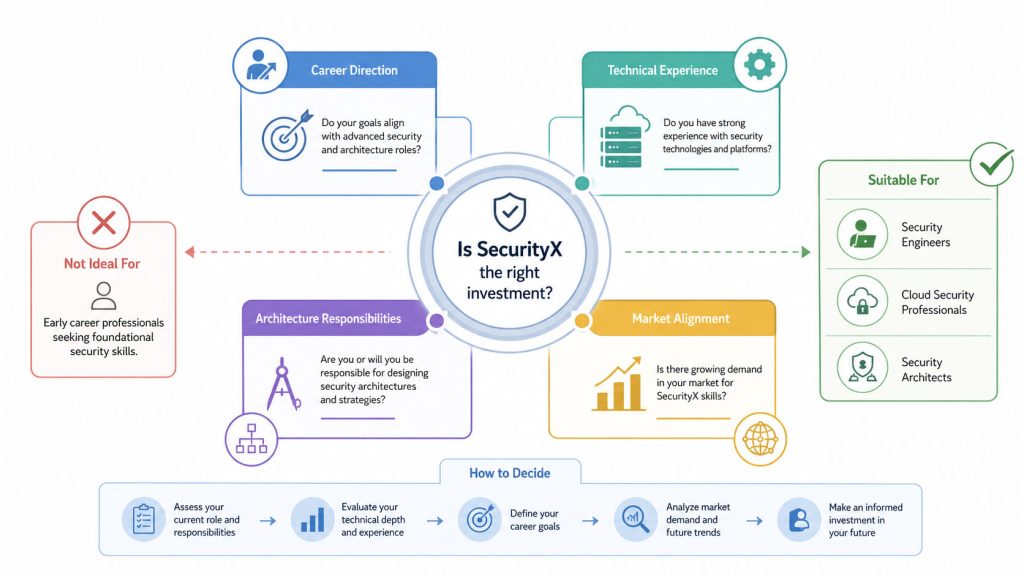
SecurityX occupies an unusual position in the cybersecurity certification market. It targets professionals who have already moved beyond foundational security work, yet it asks a deeper question: can technical experience demonstrate architectural judgment?

That distinction matters because modern security roles are increasingly defined by decisions rather than tools. A security engineer may know how to deploy controls, but a security architect must determine which controls create acceptable risk reduction within technical, operational, and business constraints.

The challenge in evaluating SecurityX is that traditional certification measurements are often incomplete. Recognition, salary impact, and job postings tell only part of the story. The more important question is whether CAS-005 validates the reasoning patterns required in complex enterprise environments.

Understanding What SecurityX Actually Measures

A common assumption about advanced cybersecurity certifications is that difficulty comes from the amount of information covered. That explanation misses the larger shift happening in security careers.

The challenge with CAS-005 is less about remembering additional technologies and more about evaluating security decisions when several answers appear technically reasonable.

Security professionals rarely work with perfect conditions. Enterprise environments contain legacy systems, regulatory constraints, limited budgets, operational dependencies, and competing priorities. A technically stronger solution may not always be the most appropriate business decision.

For example, a security architect evaluating access controls is not only asking whether stronger authentication improves security. The real questions include:

  • How will existing applications handle the change?
  • Which users require different access models?
  • What operational risks appear during migration?
  • Are temporary compensating controls acceptable?

This difference separates implementation knowledge from architectural judgment.

CAS-005 is valuable because it reflects a professional reality: advanced security work is often about choosing between imperfect options.

A firewall engineer may understand how segmentation works. A security architect must determine whether segmentation is the correct investment compared with identity improvements, application security changes, or monitoring enhancements.

The distinction is subtle but important.

SecurityX is not simply measuring whether someone knows security concepts. It is evaluating whether that knowledge can be applied across interconnected environments.

Understanding What SecurityX Actually Measures

Where SecurityX Fits in the Certification Landscape

Security certifications are often placed on a simple ladder:

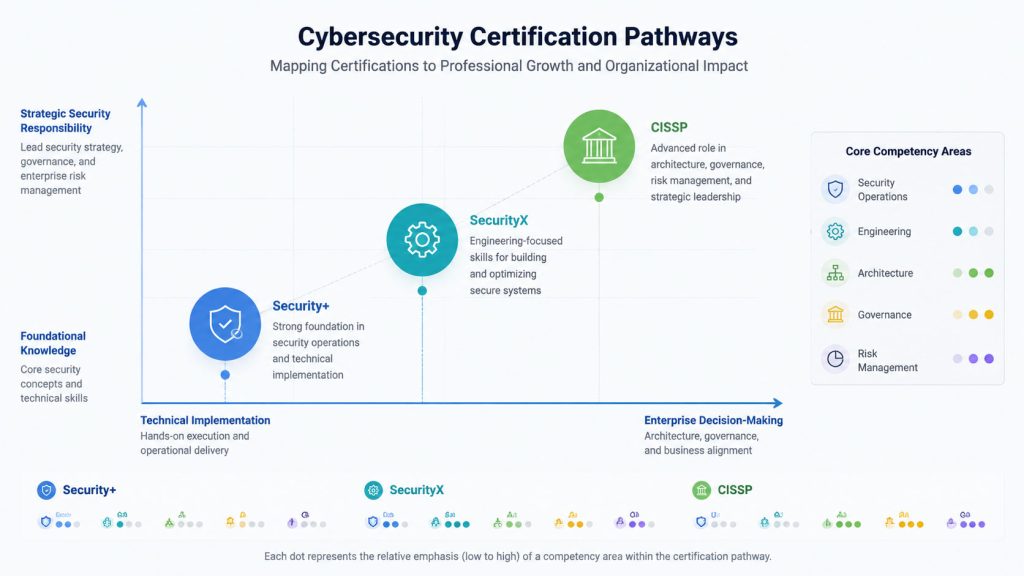
  • Security+ for foundational knowledge
  • SecurityX for advanced technical capability
  • CISSP for security leadership

That model is convenient, but it does not fully describe how professionals actually use these certifications.

SecurityX is not simply the “next level” after Security+. The transition is not about learning more security terms. It is about moving from understanding controls to evaluating how controls should be designed, prioritized, and implemented.

Security+ provides professionals with the language of cybersecurity:

  • threats
  • vulnerabilities
  • controls
  • risk concepts
  • security operations

SecurityX assumes that foundation already exists and focuses on what happens when security decisions become more complex.

The difference is responsibility.

A Security+ professional may need to understand why least privilege matters.

A SecurityX-level professional may need to decide how least privilege should work across thousands of identities, cloud platforms, legacy applications, and business processes.

That distinction explains why experience matters before attempting CAS-005. A professional who has spent years operating security tools may still need broader exposure to architecture, governance, and risk decisions.

The strongest candidates are usually not those who have collected the most certifications. They are professionals who have started making security decisions that affect systems, teams, and organizations.

SecurityX vs Security+ vs CISSP

SecurityX vs Security+

The comparison between SecurityX and Security+ is often presented as a difficulty comparison. That is incomplete.

The more meaningful difference is the type of professional thinking each certification represents.

Security+ validates foundational cybersecurity knowledge. It helps professionals understand the purpose of security controls and the role those controls play within an organization.

SecurityX examines what happens after that foundation exists.

The question changes from:

“Do you understand this security concept?”

to:

“Given these competing requirements, what security decision creates the best outcome?”

That difference appears clearly in areas such as identity management, cloud security, and risk analysis.

A Security+ candidate may need to understand the purpose of multi-factor authentication.

A SecurityX candidate may need to evaluate whether an organization should prioritize identity modernization, network segmentation, application redesign, or additional monitoring.

All of those options may improve security. The challenge is determining which one creates the greatest reduction in risk under real-world constraints.

This is also why SecurityX is not automatically the correct next step for every Security+ holder.

Some professionals may gain more immediate value from developing:

  • cloud engineering experience
  • security operations skills
  • threat analysis capability
  • automation skills
  • infrastructure expertise

The deciding factor is not certification sequence. It is whether the professional is moving toward security decision-making.

SecurityX vs CISSP: Different Perspectives, Not Opposing Paths

The comparison between SecurityX and CISSP is often simplified into one sentence:

SecurityX is technical. CISSP is managerial.

That description creates an inaccurate distinction.

Both certifications include technical and governance concepts. The difference is the perspective from which security problems are approached.

SecurityX aligns more closely with professionals evaluating security solutions, architecture decisions, and technical implementation strategies.

CISSP places stronger emphasis on managing security programs, organizational risk, policy development, and communication with business leadership.

A security architect deciding how to structure identity controls in a hybrid cloud environment may find SecurityX closely aligned with the technical decision process.

A security leader responsible for security governance across multiple departments may find CISSP more directly connected to their responsibilities.

Neither certification replaces the other.

The better question is not which certification is more advanced.

The better question is:

What type of security decisions does your career require you to make?

A professional designing systems may prioritize different knowledge than a professional managing enterprise security strategy.

Who Gains the Most Career Value From SecurityX?

Who Gains the Most Career Value From SecurityX

The phrase “experienced cybersecurity professional” covers too many different roles. SecurityX creates different value depending on the type of work someone performs.

Security Engineers

Security engineers are among the professionals most likely to benefit from CAS-005, but the value depends on whether their role involves architecture decisions.

An engineer focused entirely on deploying and maintaining specific technologies may receive faster returns from specialized technical training.

For example, someone working primarily with endpoint tools, firewall administration, or a single cloud platform may benefit from deeper product expertise.

The value of SecurityX increases when the role expands beyond operation.

Modern security engineers increasingly evaluate questions such as:

  • Should access controls be redesigned through identity systems or network segmentation?
  • Should a vulnerability receive immediate remediation or risk-based treatment?
  • Should an organization adopt a new platform or improve existing controls?

These decisions require understanding relationships between security domains.

That is where CAS-005 aligns with real engineering responsibilities.

Cloud Security Professionals

Cloud security has increased the importance of architectural thinking, but not because cloud platforms are simply more complicated.

The larger change is that cloud environments expose weaknesses in security design.

A cloud security problem may appear to be a configuration issue while the real problem is:

  • unclear ownership
  • weak identity processes
  • poor access governance
  • insufficient monitoring
  • incomplete architecture planning

A professional focused only on cloud services may solve the immediate technical problem.

A security architect must understand why that problem existed and how to prevent similar failures across the environment.

This broader perspective is where SecurityX becomes relevant for cloud-focused professionals.

Security Architects

Security architects represent the clearest alignment with SecurityX because architecture work requires balancing competing priorities.

Enterprise security decisions rarely involve choosing between secure and insecure options.

More often, they involve choosing between several imperfect solutions.

An architect may need to decide:

  • whether a legacy system should be isolated or replaced
  • whether additional controls justify operational complexity
  • whether cloud migration risks require redesign
  • whether security investments match business priorities

SecurityX does not create architectural experience by itself.

However, for professionals already moving toward architecture responsibilities, it can provide a structured framework for evaluating the decisions they increasingly encounter.

Risk Management, Zero Trust, and Enterprise Architecture: Where SecurityX Becomes Practical

SecurityX discussions often separate topics such as risk management, Zero Trust, and architecture into different categories. In enterprise environments, these areas are connected by one central challenge:

Security professionals must decide where security investment creates the greatest reduction in organizational risk.

That sounds straightforward, but real environments rarely provide simple answers.

A stronger security control can introduce new operational challenges. A stricter access model may improve security while creating workflow problems. A new security platform may reduce one risk while increasing complexity elsewhere.

The role of an advanced security professional is not to eliminate every possible risk. That is rarely achievable. The responsibility is to evaluate which risks require immediate action, which risks can be managed, and which investments create meaningful improvement.

Risk Management Is More Than Identifying Threats

One of the common misunderstandings about enterprise security is that the most technically severe issue should always receive the highest priority.

In practice, risk decisions depend on context.

A vulnerability affecting a low-value internal application may receive less attention than an identity weakness affecting thousands of users. A system with outdated software may represent less immediate risk than a poorly designed access process controlling sensitive information.

The technical issue matters, but the surrounding environment determines the impact.

This is where advanced security roles differ from purely operational positions.

A security analyst may identify vulnerabilities.

A security architect must determine:

  • which vulnerabilities represent meaningful business risk
  • which controls reduce exposure effectively
  • which solutions create unacceptable operational costs

CAS-005 aligns with this type of reasoning because enterprise security decisions are rarely isolated technical problems.

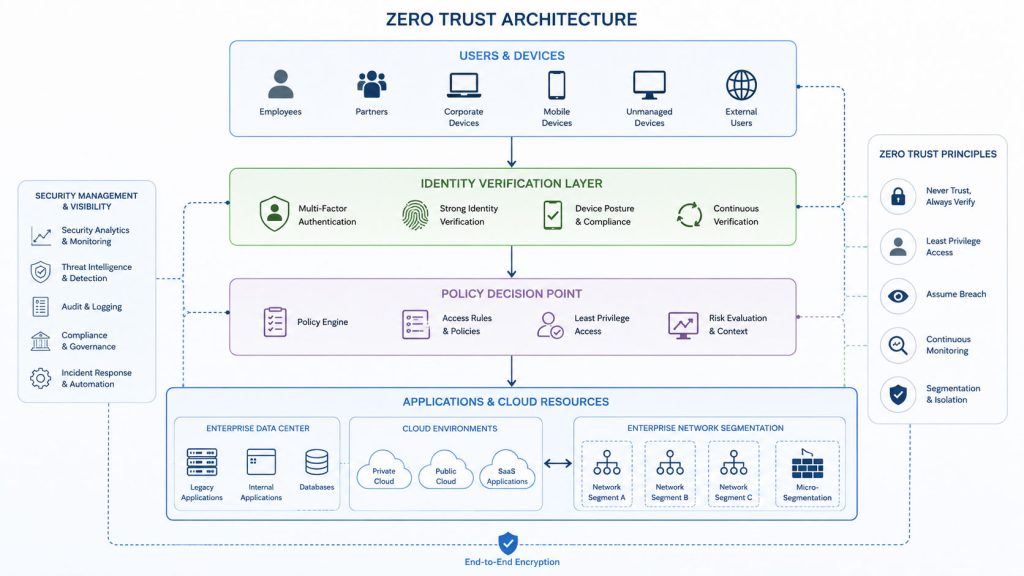
Zero Trust: Architecture Decision, Not Product Selection

Zero Trust Architecture

Zero Trust has become one of the most discussed concepts in modern security, but discussions often become focused on tools.

Organizations may purchase identity platforms, security gateways, or monitoring solutions while missing the architectural decisions required for successful implementation.

Zero Trust depends on questions such as:

  • Who should access a resource?
  • How is identity verified?
  • How are permissions reviewed over time?
  • Which applications require different security models?
  • How should trust decisions change based on risk?

The difficult part is not understanding the definition of Zero Trust.

The difficult part is applying the model inside environments with existing applications, business dependencies, and technical limitations.

For CAS-005 candidates, understanding Zero Trust means understanding implementation challenges, not only knowing terminology.

The strongest security professionals recognize that architecture decisions often determine whether security strategies succeed or fail.

Study Strategy: Preparing for CAS-005 Through Decision-Making

Preparation for CAS-005 requires a different mindset from certifications focused mainly on recognition of concepts.

The challenge is not only learning more information.

It is developing the ability to evaluate why one decision is better than another.

Study the Relationships Between Domains

A common mistake in advanced certification preparation is treating exam topics as separate categories.

Enterprise security does not work that way.

IAM decisions influence:

  • cloud security
  • compliance
  • application design
  • operational workflows

Threat modeling connects with:

  • business impact
  • architecture choices
  • risk prioritization

Incident response connects with:

  • monitoring strategy
  • governance processes
  • recovery planning

The strongest candidates understand these relationships because real security problems rarely belong to one domain.

Evaluate Practice Questions Differently

Practice questions are useful, but their value depends on how they are reviewed.

Memorizing why an answer is correct creates limited improvement.

A stronger approach is examining the decision process:

  • What risk is the scenario prioritizing?
  • Which business requirement influences the choice?
  • Why are alternative answers weaker?
  • Under what circumstances would another solution become appropriate?

This approach develops the reasoning pattern required for scenario-based questions.

When evaluating preparation resources, candidates should focus less on the number of questions provided and more on whether explanations demonstrate realistic security decision-making.

Resources such as CAS-005 Exam Preparation Resources may be considered as part of a broader preparation plan, but practice materials should be judged by scenario quality, explanation depth, and alignment with official objectives rather than question volume alone.

When SecurityX May Not Be the Best Investment

Not every experienced IT professional will receive the same value from CAS-005.

A common assumption is that more experience automatically means an advanced certification creates more benefit.

That is not always true.

A professional who specializes deeply in one technical area may receive greater career returns from expanding into adjacent skills.

Examples:

A network engineer may gain more immediate value from cloud security experience.

A cloud administrator may benefit from stronger identity and automation skills.

A security analyst may need more hands-on incident response experience.

SecurityX becomes more valuable when the professional is already moving toward broader security responsibility.

The question is not:

“Is SecurityX a good certification?”

The better question is:

“Does SecurityX measure the type of security work I want to perform?”

Measuring the Career ROI of SecurityX

Measuring the Career ROI of SecurityX

The value of SecurityX is difficult to measure only through salary increases.

Advanced certifications rarely create career movement by themselves.

Their value usually appears through several indirect benefits:

  • stronger credibility in technical discussions
  • improved ability to communicate security decisions
  • better alignment with architecture responsibilities
  • stronger foundation for senior security roles

For example, a security engineer participating in architecture reviews may find that CAS-005 concepts provide a useful framework for explaining security decisions to technical teams and leadership.

However, expectations should remain realistic.

Employers evaluate combinations of:

  • technical ability
  • project experience
  • communication skills
  • problem-solving capability
  • certifications

SecurityX can strengthen an existing professional profile, but it cannot replace evidence that someone can design, evaluate, and operate security solutions.

The Long-Term Value Question: Is SecurityX Worth It in 2026?

The strongest argument for SecurityX is not that it guarantees career advancement.

No certification can make that promise.

Its value comes from the type of thinking it encourages.

Security professionals are increasingly required to move beyond operating individual controls and toward understanding how security decisions affect entire systems.

That shift is visible across:

  • hybrid cloud environments
  • identity-focused security models
  • Zero Trust adoption
  • security architecture programs
  • enterprise risk management

For professionals already working near those responsibilities, SecurityX can provide meaningful value.

For professionals still building foundational technical experience, other investments may produce faster results.

The decision depends on career direction.

SecurityX is most useful for professionals who are transitioning from:

“how do I implement this security control?”

toward:

“which security approach creates the best outcome for this organization?”

That distinction is what separates advanced security engineering from basic security administration.

Conclusion: A Decision Framework, Not a Certification Recommendation

SecurityX is not difficult to evaluate because of exam difficulty alone.

The harder question is whether its focus matches the professional responsibilities someone wants to develop.

For security engineers moving toward architecture, cloud professionals dealing with enterprise security decisions, and technical leaders evaluating risk across complex environments, CAS-005 aligns with important industry trends.

For professionals seeking their first security role, deeper specialization, or immediate operational skills, other certifications or practical projects may provide greater returns.

The most accurate way to view SecurityX is not as a universal career accelerator.

It is a certification designed for a specific transition:

from implementing security solutions to making security decisions.

That transition is valuable, but only when it matches the direction of a professional’s career.

Editorial Notes

This article is designed as an editorial analysis rather than a traditional certification study guide. The conclusions presented here are based on a comparative review of the official CompTIA SecurityX (CAS-005) exam objectives, certification updates, publicly available cybersecurity career trends, and technical discussions within the professional security community.

Wherever multiple viewpoints exist, this article favors evidence-based reasoning over absolute conclusions. Its purpose is to help experienced IT professionals evaluate the long-term value of SecurityX from both a technical and career perspective—not simply prepare for the exam.


Research Methodology

This article was developed through a structured editorial review process that included:

  • Official CompTIA SecurityX (CAS-005) exam objectives and certification updates
  • CompTIA blog articles and published certification resources
  • Current cybersecurity job market observations
  • Community discussions from experienced certification candidates and security professionals
  • Industry documentation covering enterprise security architecture, governance, risk management, Zero Trust, and cloud security
  • Comparative analysis with related certifications, including Security+, CySA+, and CISSP

Evidence Summary

Editorial ConclusionSupporting Evidence
SecurityX evaluates architectural decision-making rather than procedural execution.CompTIA CAS-005 Exam Objectives
Business context frequently influences the best technical answer.Official exam objective scenarios and enterprise security documentation
Enterprise-level security architecture is a recurring theme throughout the certification.CompTIA SecurityX Blueprint
SecurityX aligns most closely with experienced cybersecurity roles.Current cybersecurity job market observations
Community discussions consistently emphasize reasoning over memorization.Reddit discussions and technical community feedback

Official References

  • CompTIA SecurityX (CAS-005) Exam Objectives
  • CompTIA SecurityX Certification Page
  • CompTIA Blog
  • NIST Cybersecurity Framework (CSF)
  • NIST Zero Trust Architecture (SP 800-207)
  • Microsoft Learn Security Documentation
  • AWS Security Documentation
  • Google Cloud Security Best Practices

Editorial Perspective

Unlike many certification articles that focus primarily on passing the exam, this analysis approaches SecurityX as a long-term professional investment. Rather than repeating the published objectives, the goal is to examine what the certification actually measures, how it aligns with enterprise cybersecurity roles, and where its value fits within today’s evolving security landscape.

2026 DA0-002 Complete Learning Roadmap + First-Time Pass Strategy

2026 DA0-002 data+ v2

If you’re looking to build a career in data analytics, CompTIA Data+ V2 (DA0-002) is the certification you need to prove your expertise. Whether you’re a data analyst, business intelligence professional, or looking to break into data management, this certification will help you stand out.

“I’ve coached students who started with little data experience but were able to land jobs in data management within months, thanks to DA0-002.”

In this guide, I’ll break down the study roadmap that will help you pass the DA0-002 exam on your first attempt within 6–8 weeks. You’ll gain insights from real coaching experiences and targeted strategies, ensuring that you’ll approach the exam prepared and confident.

Exam Overview & Key Changes in V2

The DA0-002 exam tests your ability to manage, analyze, and visualize data. Here’s a breakdown of the domains covered:

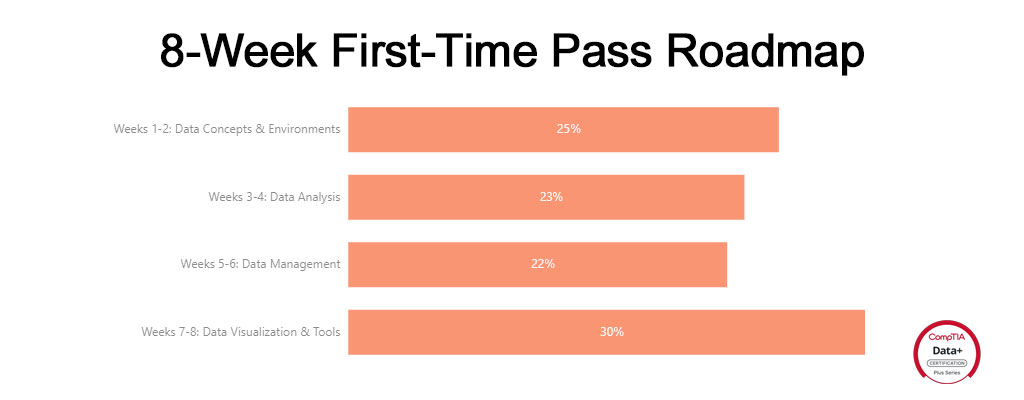
DomainWeight
Data Concepts and Environments25%
Data Analysis23%
Data Management22%
Data Visualization20%
Tools and Techniques10%

Key Change in V2: Unlike the previous version (V1), DA0-002 V2 places a stronger emphasis on hands-on, real-world data manipulation. Now, you’ll work with tools like Power BI and SQL, and deal with practical tasks such as data cleaning, data integration, and visualization.

This change makes the certification even more relevant to what employers expect. “V2 focuses more on practical skills, making the transition from learning to working easier for students,” as many of my students have shared.

8-Week First-Time Pass Roadmap

da0-002 8-Week First-Time Pass Roadmap

Let’s dive into the 8-week study roadmap, broken down by the exam domains. By following this schedule, you’ll cover all topics efficiently while focusing on your weak spots.

Weeks 1-2: Data Concepts & Environments (25%)

Focus Areas: This is the foundation of your study plan. Start by understanding data types, data structures, file formats, and databases. Also, learn about different data sources—like APIs, logs, and cloud storage systems.

Pro Tip: While this section is foundational, don’t skip it! Some students rush through the basics and struggle with later, more advanced topics. “Understanding cloud storage, databases, and infrastructure will give you the tools to tackle more complex exam sections.”

Resources:

  • Google Sheets for basic data organization.
  • SQL basics for working with relational data.

Weeks 3-4: Data Analysis (23%)

Focus Areas: Now it’s time to dive into data analysis. This includes statistical methods, data cleaning, and working with SQL queries. Understanding how to work with data visualization tools is also crucial.

What Students Often Miss: Many candidates think they can skip practice with SQL queries or overlook data exploration. This section requires hands-on practice, so make sure you’re comfortable with querying, filtering, and analyzing real data.

Pro Tip: Use Google Sheets to start practicing simple queries. Once you’re comfortable, move on to SQLite or Power BI for deeper analysis.

Weeks 5-6: Data Management (22%)

Focus Areas: This section focuses on data governance, data security, and quality assurance. Learn about data integrity, compliance, access control, and data encryption.

What Most Students Miss: Many students overlook the importance of data privacy and compliance, which are critical parts of data management. Make sure you understand data lineage and retention policies.

Pro Tip: Practice data governance in Power BI by managing access to data and using version control.

Weeks 7-8: Data Visualization & Tools (30%)

Focus Areas: The final section is all about creating data visualizations and understanding the tools necessary for effective reporting. This is where you will spend most of your time practicing Power BI for dashboard creation and SQL for advanced queries.

What Students Struggle With: PBQs (Performance-Based Questions) are a significant part of this section, requiring you to create visual reports or troubleshoot issues with real-world datasets.

Pro Tip: Time management is crucial here. Allocate 20 minutes per PBQ during practice exams. Don’t overthink small details—focus on the bigger picture and your approach to problem-solving.

Best Resources for DA0-002 Preparation

Here’s a comparison of tools and resources that I highly recommend for DA0-002 preparation.

ResourceTypeProsCons
Google SheetsFreeSimple for basic analysisLacks advanced features
SQLiteFreeExcellent for DB practiceSteeper learning curve
Power BI DesktopFreeEasy for visualizations and dashboardsLimited tutorials for beginners
Leads4Pass DA0-002PaidTargeted practice questionsCan be overwhelming with too many questions

Pro Tip: Leads4Pass has been especially helpful for my students in the final stages of preparation. It’s perfect for exam-style practice.

PBQ Strategies & Exam Day Tips

PBQs are the most challenging part of the DA0-002 exam. Here are some strategies to help you succeed:

  • Strategy #1: Approach each PBQ methodically. First, analyze the problem, then clean and format the data before diving into the visualization.
  • Strategy #2: Manage your time wisely. 20 minutes per PBQ should be enough to complete the task thoroughly.

Pro Tip: Don’t rush! Stay calm and take your time to understand each dataset before starting the analysis.

Common Pitfalls and How to Avoid Them

  1. Skipping Fundamentals: Trying to jump into data analysis before understanding basic concepts will cause trouble later.
    • Fix: Follow the study roadmap and don’t skip foundational topics like data structures and data sources.
  2. Over-Relying on Practice Tests: While practice tests are important, they won’t help you if you don’t understand the theory behind the tools and techniques.
    • Fix: Balance practice with theoretical study to reinforce your understanding.
  3. Ignoring PBQs: Many students don’t dedicate enough time to PBQs.
    • Fix: Practice PBQs regularly and ensure you can complete them within the allotted time.

Why This Roadmap Leads to Real Career Wins

The DA0-002 certification isn’t just a piece of paper—it’s your ticket to data-related jobs and career advancement. By mastering the skills required for this exam, you’ll be better equipped to work with industry-standard tools like Power BI and SQL, making you highly marketable to potential employers.

“Take John, for example. He passed the DA0-002 after 7 weeks of preparation and immediately started his role as a data analyst. His work with SQL and Power BI opened doors to new opportunities.”

FAQ

  1. How much time should I spend preparing for DA0-002?
    • Most candidates need around 6-8 weeks. Stay consistent and follow the roadmap.
  2. What’s the best resource for PBQ practice?
    • Leads4Pass offers targeted practice tests that closely mirror the real exam.
  3. Can I skip the Data Management section?
    • Absolutely not! This section is critical for understanding data integrity and compliance.
  4. How can I get better at Power BI?
    • Practice with real-world datasets and build dashboards. There are plenty of beginner tutorials online.
  5. Do I need to memorize SQL for DA0-002?
    • Yes! You need a strong understanding of SQL queries to pass the data analysis section.

CompTIA Tech+ (FC0-U71) in 2026: The Real Value, Career Impact, and Smart Strategy

CompTIA Tech+ (FC0-U71) in 2026: The Real Value, Career Impact, and Smart Strategy

In 2026, breaking into IT isn’t about knowing everything—it’s about proving you understand how technology fits together. That’s exactly where CompTIA Tech+ (FC0-U71) comes in. It’s not just a beginner cert—it’s a signal that you’re ready to think in systems, not just memorize tools. With AI, automation, and digital workflows reshaping entry-level roles, Tech+ is quietly becoming the new baseline for tech literacy, replacing older assumptions around ITF+.

🔍 What CompTIA Tech+ Really Represents (Not Just the Official Definition)

Beyond the syllabus

At first glance, CompTIA Tech+ (FC0-U71) looks like a standard entry-level certification. The official description emphasizes foundational skills—hardware, software, networking, security—but that barely scratches the surface.

What’s actually happening here is more subtle. Tech+ is designed as a decision-making certification, not just a knowledge checkpoint. It tests whether you can interpret technology, not just recognize it. For example, understanding cloud computing isn’t about defining it—it’s about knowing when it’s appropriate and why it matters in a workflow.

In practical terms, Tech+ teaches you to think like someone who can navigate complexity. That’s critical today because modern IT environments are no longer siloed. Even entry-level roles now touch cloud services, automation tools, and AI-assisted systems. The certification reflects that shift by blending concepts like data, security, and software logic into one unified framework.

Role in modern IT literacy

Here’s the uncomfortable truth: traditional “basic IT knowledge” is no longer enough. In 2026, even non-technical roles interact with APIs, dashboards, automation tools, or AI copilots. Tech+ sits right at that intersection.

Instead of preparing you for a specific job, it prepares you for how technology behaves in real environments. Think of it as learning the grammar of IT before writing sentences. That’s why CompTIA positions it as a pre-career certification—it helps candidates decide whether IT is the right path before committing deeper.

⚖️ Tech+ vs ITF+ vs A+: Where It Actually Fits

Key differences

The confusion between Tech+, ITF+, and A+ is real—and understandable. Tech+ essentially replaces ITF+, but with a more modern structure aligned to current tech trends.

A+, on the other hand, is not a replacement—it’s a progression.

  • ITF+ (FC0-U61): Legacy entry-level cert (being phased out)
  • Tech+ (FC0-U71): Modern foundational certification
  • A+: Hands-on technical certification for IT support roles

Decision-making insights

Here’s the insight most guides miss: choosing between these isn’t about difficulty—it’s about intent.

  • Exploring IT? → Tech+
  • Committing to IT support? → A+
  • Already have experience? → Skip Tech+

Comparison Table

CertificationPurposeDepthCareer ImpactStatus
ITF+Basic IT awarenessVery lowMinimalRetiring
Tech+Foundational IT literacyModerateDirectionalCurrent
A+Technical job readinessHighStrongIndustry standard

This positioning matters because employers don’t evaluate these equally. Tech+ signals potential, while A+ signals capability.

🎯 Who Should (and Should NOT) Take FC0-U71

Ideal candidates

Tech+ works best for people at a very specific stage:

  • Career changers testing the waters
  • Students unsure about IT specialization
  • Non-technical professionals moving into tech-adjacent roles
  • Beginners with zero structured IT knowledge

If you’re asking, “Is IT even for me?”—this certification answers that question efficiently.

Who should skip it

This is where being honest matters. Tech+ is not for everyone.

Skip it if you:

  • Already understand networking basics, OS concepts, and security fundamentals
  • Have hands-on experience (even informally)
  • Plan to go straight into IT support roles

In those cases, going directly to A+ saves time and delivers more ROI. Tech+ becomes redundant because its value lies in orientation, not specialization.

📊 Exam Difficulty: What Makes FC0-U71 Easier — and What Doesn’t

Domains explained

The exam is structured across six domains, including IT concepts, infrastructure, software, databases, and security.

Here’s the catch—it’s broad, not deep.

  • You won’t configure networks
  • You won’t write production code
  • You won’t deploy security systems

Instead, you’ll understand how they work together.

Real difficulty expectations

On paper, the exam looks easy:

  • ~70 questions
  • 60 minutes
  • Passing score: 650/900

But difficulty isn’t about complexity—it’s about context switching.

You might jump from:

  • Binary systems →
  • Cloud computing →
  • Security concepts →
  • Databases

That mental switching is what catches people off guard. The exam rewards conceptual clarity, not memorization.

🧠 Smart Preparation Strategy (What Actually Works)

Efficient study methods

Most people over-study Tech+. That’s a mistake.

A smarter approach focuses on:

  • Understanding concepts, not memorizing definitions
  • Linking topics together (e.g., security + networking + data)
  • Practicing scenario-based thinking

Instead of asking “What is this?”, ask “When would I use this?”

Tools and resources

The most effective preparation blends official materials with practical testing tools. CompTIA’s own learning resources provide structure, but practice exams sharpen decision-making.

A practical supplemental resource is:
👉 https://www.leads4pass.com/fc0-u71.html

Used correctly, tools like this help you identify weak spots quickly without wasting time on content you already understand.

The goal isn’t to study longer—it’s to close knowledge gaps faster.

🛤️ Career Path & Certification Roadmap

From Tech+ to advanced certs

Tech+ is not an endpoint—it’s a launchpad.

Typical progression:

Each step increases specialization and job readiness.

Job role alignment

Here’s how that translates into real roles:

  • Tech+ → Exploration, internships, admin support
  • A+ → Help desk, IT support specialist
  • Network+ → Network technician, junior admin
  • Security+ → Security analyst, SOC roles

This pathway reflects how skills stack—not just certifications.

🌐 Industry Relevance in 2026

AI and automation impact

AI hasn’t reduced the need for entry-level IT—it’s changed it.

Now, entry-level professionals are expected to:

  • Understand AI-assisted tools
  • Interpret system outputs
  • Manage automated workflows

Tech+ directly reflects this shift by including exposure to AI concepts and modern technologies.

Is Tech+ future-proof?

Here’s the honest answer: Tech+ isn’t future-proof by itself—but it doesn’t need to be.

Its value lies in:

  • Building adaptable thinking
  • Creating a mental framework for learning

In a world where tools change constantly, that foundation matters more than specific technical skills.

Conclusion

Tech+ is not about proving you’re technical—it’s about proving you’re ready to become technical. That distinction is what makes it relevant in 2026. It filters out guesswork and gives you clarity: whether to move forward in IT—or pivot before investing deeper.

FAQs

1. Is CompTIA Tech+ worth it in 2026?

Yes, but only if you’re at the exploration stage. It’s valuable for understanding IT, not for landing technical jobs directly.

2. Is Tech+ replacing ITF+?

Yes. Tech+ is the updated version with broader and more modern coverage aligned with today’s technology landscape.

3. How long does it take to prepare for FC0-U71?

Most candidates prepare in 2–4 weeks, depending on prior exposure to technology concepts.

4. Can I skip Tech+ and go straight to A+?

Absolutely. If you already understand basic IT concepts, skipping Tech+ is often the better choice.

5. Does Tech+ expire?

No, it is considered a lifetime certification, unlike many higher-level CompTIA certifications.

XK0-006 Exam Guide: Key Changes & Smart Strategies for Transitioning from XK0-005

xk0-006 exam guide

If you were originally preparing for XK0-005 and suddenly realized it’s retired, landing on XK0-006 feels like someone moved the goalpost overnight. I’ve had multiple learners tell me the same thing: “Now there’s automation, containers, even AI… do I need to relearn everything?”

That reaction is completely normal. The biggest problem right now isn’t even the exam—it’s the fragmented learning resources. Some courses still follow 005, others partially updated, and Reddit threads often mix both versions without context.

The anxiety usually comes from seeing new buzzwords stacked into the objectives. It makes the exam look like a full DevOps certification. But once you break it down properly, the picture becomes much clearer—and a lot less intimidating.

The Good News Most People Miss

Here’s the part almost nobody emphasizes enough:
roughly 70% of XK0-005 knowledge is still directly usable in XK0-006.

Core Linux hasn’t changed:

  • File systems
  • Permissions
  • Process management
  • Networking basics

What has changed is context.

Instead of asking “what does this command do,” XK0-006 leans toward:
👉 “How does this apply in a modern Linux environment?”

Once you shift your mindset from memorization → application, the transition becomes much smoother.

My Experience with Recent XK0-006 Candidates (Reality Check)

Since XK0-006 (Linux+ V8) is still relatively new, most insights right now come from recent candidate experiences, early exam feedback, and direct transitions from late-stage XK0-005 preparation.

What I have done over the past few months is:

  • Help a small group of candidates transition from late-stage XK0-005 prep
  • Analyze recent Reddit pass/fail threads
  • Compare real exam feedback with official objectives

Across the candidates I’ve guided and discussions I’ve had with a DevOps engineer (RHCSA-certified), one pattern is already very clear:

👉 People who pass treat XK0-006 as a practical exam, not a theory test.

And the ones who fail? They usually over-read and under-practice.

XK0-006 Exam Objectives Breakdown (Accurate 2026 Data)

Domain Weight Comparison Table (Official Sources)

DomainXK0-005 (V7 Official)XK0-006 (V8 Official)
System Management32%23%
Security21%18%
Scripting, Containers & Automation19%17%
Troubleshooting28%22%
Services & User Management20%

What These Changes Actually Mean in Practice

This is where most guides stay surface-level—but this is exactly where your strategy should change.

1. System Management dropped (32% → 23%)
This doesn’t mean it’s less important. It means CompTIA assumes you already know it. Expect fewer direct questions, more embedded scenarios.

2. New Domain: Services & User Management (20%)
This is one of the most important additions. Instead of scattered topics, it’s now structured. In practice, you’ll see:

  • systemd service handling
  • user/group management in real scenarios
  • permission-related troubleshooting

3. Automation remains significant (17%)
Even though the percentage looks similar, the depth changed. It now includes:

  • Containers
  • Config management awareness
  • Version control concepts

4. Troubleshooting still dominates (22%)
This is huge. It confirms the exam is still scenario-heavy. If you can’t debug under pressure, you’ll struggle.

Deep Dive into New Topics (What Actually Shows Up)

Containers (Docker & Podman — What You Really Need)

This is where most people overreact.

From recent candidate feedback:

  • Basic container lifecycle commands show up
  • Some PBQs may involve identifying issues
  • No deep orchestration (no Kubernetes-level complexity)

A candidate I spoke with said:

“I expected Docker to be brutal. It was actually very basic—more like awareness + simple usage.”

That matches everything I’ve seen so far.

Automation & Scripting (Where You Should Focus)

This section is more about understanding workflows than coding expertise.

You should be comfortable with:

  • Bash scripting basics
  • Reading simple automation logic
  • Understanding config management concepts

A DevOps engineer I discussed this with put it bluntly:

“If you can read a script and understand what it’s doing, you’re already ahead.”

That’s the level XK0-006 is targeting.

AI Best Practices (The Most Overhyped Section)

Let’s clear this up quickly.

Based on real feedback:

  • Usually 1–2 questions max
  • No coding
  • No deep ML concepts

It’s more about:

  • Responsible usage
  • Data awareness
  • When NOT to use AI

Honestly, I’ve yet to see anyone fail because of this section.

Hybrid Cloud Troubleshooting (The Sneaky One)

This is not labeled as a separate domain, but it shows up inside troubleshooting.

You might see:

  • Service failures across environments
  • Network misconfigurations
  • Permission issues in shared systems

This is where pure “textbook learners” get caught off guard.

Where Most Candidates Struggle (Recent Patterns)

After reviewing multiple recent exam experiences, a few consistent issues stand out:

  • Knowing commands but not applying them
  • Freezing during PBQs
  • Ignoring troubleshooting practice
  • Overstudying theory-heavy topics

One Reddit user summed it up perfectly:

“The exam wasn’t hard—I just wasn’t used to thinking through problems fast enough.”

That’s exactly it.

My Recommended 6–8 Week XK0-006 Study Plan (2026)

Weekly Breakdown

  • Week 1–2: Core Linux refresh (commands + system basics)
  • Week 3: Services, users, permissions
  • Week 4: Security + troubleshooting scenarios
  • Week 5: Containers + automation basics
  • Week 6: Practice + weak areas
  • Week 7–8: PBQs + full mock exams

Daily Study Structure

Keep it simple but consistent:

  • 1–2 hours per day
  • 60% hands-on
  • 40% theory

If you’re not using a Linux environment daily, you’re leaving points on the table.

My Recommended Learning Stack

This is what I personally suggest based on what’s working right now:

  • Official objectives (baseline clarity)
  • Hands-on labs (critical)
  • Practice exams (gap detection)

Think of it as a loop:
Learn → Apply → Break → Fix → Repeat

Best Resources (Updated & Practical)

Start with:

  • CompTIA Linux+ V8 official page
  • Official objectives PDF
  • YouTube lab content (101 Labs style)
  • GitHub lab repositories
  • Sybex Study Guide

When you need more structured practice—especially for PBQs and weak areas—many candidates also use:
https://www.leads4pass.com/xk0-006.html

The key is balance. No single resource is enough on its own.

How to Practice PBQs Effectively

PBQs test one thing: can you actually use Linux?

Best approach:

  • Use a VM (VirtualBox or similar)
  • Break configurations intentionally
  • Fix them without notes

That uncomfortable feeling? That’s exactly what prepares you for the exam.

Final Thoughts from a Linux Admin

XK0-006 isn’t harder—it’s just more honest.

It reflects how Linux is actually used today:

  • Mixed environments
  • Automation
  • Real troubleshooting

If you lean into hands-on practice early, the exam becomes much more predictable.

Conclusion

The transition from XK0-005 to XK0-006 isn’t a reset—it’s an upgrade.

Most of what you already know still applies. The real difference is how you apply that knowledge in more practical, modern scenarios. XK0-006 rewards people who can do, not just remember.

If you start building a lab environment today—even something simple—you’ll notice progress within days. Commands stop feeling abstract, troubleshooting becomes more intuitive, and your confidence grows naturally with each session.

At the same time, don’t underestimate the value of targeted practice resources. Hands-on labs should be your foundation, but structured question banks—especially those focused on PBQs and weak areas—can make a noticeable difference in how quickly you improve. This is where tools like Leads4pass come in handy for many candidates, helping reinforce exam-style thinking alongside your daily lab work.

Stick with a consistent routine for 6–8 weeks, combine real command-line practice with focused review, and you won’t just pass—you’ll actually feel like someone who can handle Linux in real-world situations.

And honestly, that’s the part you’ll appreciate the most a few months from now.

FAQs

Is XK0-006 harder than XK0-005?

Not necessarily harder, but more practical and scenario-based.

How much time should I spend on AI topics?

A few hours is enough. Focus on understanding concepts, not depth.

Are PBQs really that important?

Yes. They are often the deciding factor in passing.

Can I pass without real lab practice?

Highly unlikely. Hands-on experience is essential.

What’s the fastest way to transition from XK0-005?

Focus on new areas (automation, containers, services) and practice daily in a Linux environment.

CS0-003 Exam Guide: What the CompTIA CySA+ Study Guides Don’t Tell You

The CompTIA CySA+ exam (CS0-003) is a major milestone for cybersecurity professionals, SOC analysts, and IT professionals aiming to elevate their careers. While most study guides cover the basics, there are some key areas that they fail to address — areas that could make or break your success on exam day. In this guide, we’ll explore what you need to know to truly prepare for the CySA+ exam and avoid common pitfalls that many candidates fall into.

Why the CS0-003 Exam Is Harder Than Most People Expect

CS0-003 Exam

The CS0-003 exam isn’t just a memorization test — it’s a real-world assessment of your cybersecurity analysis skills. Most study guides focus on theoretical knowledge, but the exam requires you to think like a Security Operations Center (SOC) analyst. Here’s why the CS0-003 exam is more challenging than many anticipate:

Shift from Theory to Real-World Analysis

Unlike certifications such as Security+, the CySA+ exam requires you to demonstrate the ability to apply security knowledge in real-world scenarios. For example, you won’t just be asked to recall facts about network security. Instead, you will be required to analyze network logs and spot anomalies, a skill that reflects the day-to-day responsibilities of a SOC analyst.

SOC Workflow Thinking

SOC analysts work under pressure, analyzing threats in real-time. The CS0-003 exam evaluates your ability to perform similar tasks, such as identifying malicious activity from a variety of alerts, using security tools to track intruders, and responding to incidents swiftly. The exam doesn’t just test your knowledge — it tests your decision-making process in high-stakes situations.

PBQ Simulations

Performance-based questions (PBQs) are a hallmark of the CySA+ exam. These questions simulate real-world environments where you must use tools and tactics to solve problems, rather than simply recalling facts. You’ll face scenarios like interpreting SIEM (Security Information and Event Management) alerts or analyzing suspicious network traffic, which require critical thinking and analysis.

What the CySA+ CS0-003 Exam Actually Tests

What the CySA+ CS0-003 Exam Actually Tests

The CS0-003 exam is divided into several domains, with each focusing on different aspects of security operations. Here’s a breakdown of what you’ll be tested on:

DomainWeight
Security Operations33%
Vulnerability Management30%
Incident Response20%
Reporting & Communication17%

Why Security Operations Dominates the Exam

Security operations represent the core of the exam. As the largest domain, it accounts for 33% of the total exam weight. This domain emphasizes your ability to monitor, detect, and respond to security events. You’ll need to demonstrate expertise in using common SOC tools and processes to safeguard an organization’s network.

Exam Structure and Scenario-Based Questions

The exam uses a combination of multiple-choice and PBQ formats. The multiple-choice questions test your theoretical knowledge, while PBQs simulate practical scenarios that you would face in a SOC. This structure ensures that you’re not just familiar with security concepts, but also with how to apply them effectively under pressure.

The Biggest Mistake Most CS0-003 Study Guides Make

The Biggest Mistake Most CS0-003 Study Guides Make

Many study guides make the mistake of focusing too much on terminology and memorization. While it’s essential to understand basic concepts, memorizing definitions won’t help you pass the exam. Here’s why:

The Exam Demands Detection Logic and Threat Investigation

The CySA+ exam goes beyond memorization. It tests your ability to apply security analysis skills, such as detecting threats, interpreting logs, and investigating suspicious activity. For instance, you might be asked to examine a SIEM alert and identify whether it’s a false positive or a legitimate threat. Understanding the logic behind detecting these events is far more valuable than memorizing terms.

SIEM Alerts and Network Traffic Analysis

The exam is designed to simulate real-world security monitoring. You might be asked to analyze logs from a SIEM tool or identify indicators of compromise in network traffic. These tasks require a deep understanding of the various tools used in a SOC and how to interpret the data they generate.

Performance-Based Questions: The Real Challenge

Performance-Based Questions:  cs0-003

PBQs are arguably the most challenging part of the CS0-003 exam. While they might seem straightforward, they are designed to test your ability to think critically and act quickly under pressure. Here’s why they’re so difficult:

Log Analysis and Attack Investigation

PBQs often involve analyzing raw logs to determine the nature of an attack. For example, you might need to identify whether a suspicious pattern in network traffic is the result of a DDoS attack or an insider threat. To succeed, you must be familiar with attack vectors and how to spot the early signs of a breach.

Security Tool Configuration and Correlating Events

Another common PBQ scenario involves using tools to identify and correlate security events. You’ll need to demonstrate your knowledge of how different tools interact, as well as how to configure them to provide meaningful data for incident response.

Common PBQ Mistakes

One of the most common mistakes candidates make is treating PBQs like multiple-choice questions. Instead of analyzing the data and considering all possible solutions, many candidates rush to make a decision. This rush often leads to incorrect conclusions, which can severely impact their score.

How Successful Candidates Actually Prepare

cs0-003 exam prep

To truly succeed on the CS0-003 exam, you need to adopt a different study strategy — one that focuses on developing your skills in a SOC environment. Here’s a three-step approach:

Step 1 — Learn SOC Workflows

Understanding how a SOC operates is critical for success. This includes knowledge of tools, workflows, and how analysts collaborate to detect and respond to threats. The exam tests your ability to think like a SOC analyst, so you need to be familiar with real-world scenarios.

Step 2 — Practice Scenario Analysis

Reading through theoretical materials isn’t enough. You need to practice applying your knowledge in real-world scenarios. This can involve using simulation tools, analyzing log files, and working through practice PBQs to build your problem-solving skills.

Step 3 — Use Realistic Practice Questions

Many candidates recommend using curated practice materials that closely mimic the actual exam. One resource that has been popular in the cybersecurity community is Leads4Pass, which offers practice exams designed to simulate the real-world CySA+ experience. These materials provide a more realistic sense of the types of questions you’ll encounter on the actual exam.

Recommended Learning Path for CySA+

If you’re serious about pursuing a career in cybersecurity, the CySA+ exam is an essential stepping stone. Here’s an example of a certification progression to help guide your learning:

LevelCertification
EntrySecurity+
IntermediateCySA+
AdvancedSecurityX

Following this path ensures that you’re building a strong foundation before tackling more advanced certifications like SecurityX (An advanced cybersecurity certification for security architects and senior security engineers.).

Free CS0-003 Practice Questions (PDF)

To help you prepare, I’ve created a free set of CS0-003 practice questions in PDF format. Download the practice questions to test your readiness for the exam and get a feel for the types of questions you’ll face.

Final Thoughts: CS0-003 Is a Security Analyst Exam, Not a Memorization Test

In conclusion, the CS0-003 exam is designed to test your ability to think like a cybersecurity analyst. The exam evaluates your real-world security analysis skills, threat detection capabilities, and incident response thinking. It’s not a memorization test — it’s a hands-on evaluation of your practical knowledge and decision-making ability. To pass, you’ll need to understand SOC workflows, practice real-world scenarios, and develop the critical thinking required to respond to security incidents.

FAQs

  1. How many questions are on the CS0-003 exam?
    The CS0-003 exam contains up to 85 questions, with a mix of multiple-choice and performance-based questions.
  2. What is the passing score for the CySA+ exam?
    The passing score for the CS0-003 exam is 750 out of 900.
  3. Are practice exams helpful for CySA+ preparation?
    Yes, but make sure you use realistic practice exams that simulate the actual test environment, including PBQs.
  4. What tools do I need to be familiar with for the CS0-003 exam?
    Familiarity with SIEM tools, vulnerability management platforms, and incident response tools is essential for the exam.

CompTIA A+ 220-1201 (Core 1) Real-World Prep: My Battle-Tested Strategies to Pass on Your First Attempt

CompTIA A+ 220-1201 (Core 1) exam

When I first started coaching people for CompTIA A+ 220-1201 (Core 1), something became obvious very quickly. Plenty of candidates knew the material, yet froze when questions felt like real incidents instead of classroom prompts. I saw the same thing when I sat for 220-1201 myself—especially in networking and troubleshooting scenarios where multiple answers looked “correct,” but only one matched how work actually gets done.

This version of Core 1 doesn’t reward surface-level familiarity. It tests whether you can think like the person responsible when something stops working and users are waiting.

That’s what this guide is about: closing that gap so you don’t just pass—you pass confidently.

Why CompTIA A+ Core 1 Still Decides Who Gets Hired

After more than a decade in IT support and training, I can say this clearly: CompTIA A+ Core 1 still shapes hiring decisions. Recruiters may not know every exam detail, but they trust what A+ represents—baseline competence, structured thinking, and readiness for real environments.

With A+ Core 1 V15, CompTIA leaned into:

  • Hybrid and remote work support
  • Practical networking judgment
  • Cloud awareness without vendor lock-in
  • Troubleshooting under limited access

If you want an entry-level IT role, this exam remains one of the most reliable ways to prove you’re ready.

220-1201 Core 1 V15: What the Exam Really Focuses On

Before studying anything, you need to understand the battlefield.

Exam Structure

  • Up to 90 questions
  • Multiple choice, drag-and-drop, and PBQs
  • 90 minutes total testing time

Domain Weight Breakdown

  • Mobile Devices – 13%
  • Networking – 23%
  • Hardware – 25%
  • Virtualization & Cloud – 11%
  • Hardware & Network Troubleshooting – 28%

Key Changes From 220-1101

From a practical standpoint:

  • Networking carries more weight and realism
  • Remote diagnosis scenarios are common
  • Type 1 vs Type 2 hypervisors are clearly separated
  • Cloud concepts like shared infrastructure matter
  • The formal CompTIA troubleshooting steps are no longer isolated—but the logic behind them is everywhere

Roughly 87% overlaps with the previous version. The remaining portion is where preparation style makes the difference.

Hardware Combat Zone: Lessons Learned From Real Break-Fix Jobs

Hardware questions don’t test whether you’ve memorized specs. They test whether you recognize failure patterns.

In the real world, I rarely see hardware “die cleanly.” Instead, you’ll see:

  • Random shutdowns from failing power supplies
  • Systems booting only with certain RAM sticks
  • Drives that technically work but crawl under load

How You Should Train

  • Identify symptoms before causes
  • Learn what intermittent failure looks like
  • Understand what can be tested quickly onsite

If a question feels vague, that’s intentional. The exam wants your best diagnostic move, not a full repair plan.

Mobile Devices Under Pressure: What Fails in Real Life

Mobile device questions in 220-1201 reflect support tickets more than labs.

Common scenarios include:

  • Email not syncing on corporate phones
  • Battery complaints tied to usage patterns
  • Touch issues that aren’t display failures

Your advantage comes from separating:

  • Hardware faults
  • OS or app behavior
  • Policy or configuration limits

Once you do that, most wrong answers eliminate themselves.

Networking Labyrinth: The Hidden Problems That Kill Connections

Networking is where many confident candidates lose momentum.

The exam loves scenarios like:

  • Wi-Fi connected but no internet access
  • VPN connected with limited resource access
  • Devices working locally but failing remotely

You must be comfortable with:

  • Ports and protocols in context
  • Cable types and signal behavior
  • SOHO router logic

The key question to ask yourself:
What would I check first if I couldn’t touch the device?

Virtualization & Cloud Demystified: Thinking Like the Exam Writer

This section feels intimidating until you simplify it.

  • Type 1 hypervisor: Runs directly on hardware
  • Type 2 hypervisor: Runs on top of an OS

Cloud questions usually test:

  • Resource sharing
  • Scalability
  • Responsibility boundaries

If you visualize cloud services as shared infrastructure rather than individual machines, the logic becomes clear.

Printers and Power: The Small Topics That Steal Big Points

Printers show up on the exam because they cause real-world pain.

Know how to recognize:

  • Fuser-related defects
  • Toner vs drum issues
  • Ink problems that mimic hardware failure

Power topics matter too:

  • Surge protectors vs UPS
  • Brownouts vs blackouts

These questions are straightforward if you’ve seen the symptoms before.

Fault Hunting in the Field: My On-the-Spot Diagnostic Framework

This is how I troubleshoot on the job—and how I approach PBQs:

  1. Define the symptom precisely
  2. Separate hardware from connectivity
  3. Change only one variable
  4. Observe results before acting again

This mindset aligns perfectly with how CompTIA frames scenarios.

Preparing the Way Technicians Actually Learn

Strong candidates don’t just read—they interact.

What works:

  • Explaining answers aloud
  • Sketching network paths
  • Labeling ports and components
  • Teaching concepts to someone else

If you can walk someone through a fix, you’re ready for the exam.

Hands-On Practice Without Expensive Gear

You don’t need enterprise equipment.

Useful practice setups:

  • An old PC for hardware swaps
  • Free virtualization tools
  • Your home router’s admin interface
  • Built-in Windows networking tools

Practical familiarity beats polished simulations.

Mistakes I See Strong Candidates Make Over and Over

These patterns show up constantly:

  • Fixing before diagnosing
  • Ignoring question context
  • Rushing through PBQs

Slow down just enough to align your thinking with the scenario.

Exam-Day Execution: Managing Time, Stress, and Judgment

My personal approach:

  • Handle PBQs early
  • Flag uncertain questions
  • Remove wrong answers aggressively
  • Trust your reasoning

Confidence grows when your process is solid.

Resources I Personally Trust (Free and Paid)

What I recommend based on experience:

For up-to-date, exam-aligned practice, I also used the 220-1201 exam dumps from Leads4Pass to reinforce networking and troubleshooting scenarios.
👉 https://www.leads4pass.com/220-1201.html

Use it to strengthen understanding—not as a shortcut.

What Comes After Core 1: Transitioning to Core 2

Once 220-1201 is done, momentum matters.

Core 2 (220-1202) shifts toward:

  • Operating systems
  • Security fundamentals
  • Software troubleshooting

If you want continuity, I’ve already mapped that transition in my CompTIA A+ 220-1202 Core 2 V15 guide, focusing on what changes mentally between the exams.

From Certification to Career Momentum

Passing CompTIA A+ reshaped my career. It validated my experience and opened doors that stayed closed before. More importantly, it sharpened how I approach problems under pressure.

You can reach that point too—with the right preparation and mindset.

Conclusion

CompTIA A+ 220-1201 (Core 1) rewards practical judgment, structured thinking, and situational awareness. When you prepare with real-world logic instead of surface familiarity, the exam becomes predictable—and passing on your first attempt becomes realistic. Stay focused, practice intentionally, and trust the process.

FAQs

1. Is CompTIA A+ 220-1201 harder than 220-1101?
It’s more realistic, especially in networking and remote support scenarios.

2. How long should preparation take?
Most candidates succeed with 6–10 weeks of focused study.

3. Are PBQs critical?
Yes. They heavily influence your final score.

4. Do I need job experience to pass?
No, but hands-on practice significantly improves performance.

5. Should I take Core 1 before Core 2?
Yes. Many candidates find that order more manageable.

CompTIA A+ 220-1202 (Core 2 V15) Ultimate Study Guide: 10 Key Tips to Pass on Your First Try

CompTIA A+ 220-1202

If you’re starting your IT career in 2025, the CompTIA A+ 220-1202 (Core 2 V15) certification is your best foundation. It’s globally recognized as the entry-level standard for IT professionals, proving your ability to troubleshoot, secure, and manage diverse operating systems — from Windows to Linux to mobile OS.

Whether you’re aiming to become a Help Desk Technician, IT Support Specialist, or Field Engineer, this certification opens real-world opportunities in both enterprise and remote tech support environments.

How many exams for A+ certification?

To earn the CompTIA A+ certification, candidates must pass two exams: 220-1201 (Core 1) and 220-1202 (Core 2).

Core 1 focuses on hardware, networking, and mobile device fundamentals, while Core 2 emphasizes operating systems, security, software troubleshooting, and operational procedures.

You must pass both exams to become officially A+ certified.

This dual-exam structure ensures you gain not only theoretical knowledge but also the practical, cross-platform skills needed in real-world IT environments.

Understanding the CompTIA A+ 220-1202 Exam Structure

Exam Overview

  • Exam code: 220-1202 (Core 2 V15)
  • Version released: 2025
  • Question types: Multiple-choice and performance-based (PBQs)
  • Duration: 90 minutes
  • Passing score: 700 out of 900
  • Languages available: English, Japanese, Portuguese, Spanish, Thai, and more.

Exam Domain Breakdown

Based on the official CompTIA 220-1202 objectives:

DomainPercentageKey Focus
Operating Systems28%Installation, file systems, Windows tools, OS upgrades
Security28%Encryption, access control, malware prevention, wireless protocols
Software Troubleshooting23%Diagnosing OS and app issues, mobile troubleshooting, security fixes
Operational Procedures21%Documentation, safety, communication, backup & recovery

Why CompTIA A+ Is Worth Your Time

In 2025, CompTIA A+ remains the most in-demand certification for IT support. Employers still treat it as a baseline qualification for entry-level tech roles.

According to the 2025 CompTIA Workforce Study, certified professionals earn 15–25% more and have a 40% higher promotion rate in the first year.

Compared with Microsoft Certified: Fundamentals or Cisco CCST, the A+ covers a broader range of practical IT troubleshooting and operating system management — perfect for those entering IT without a degree.

What’s Covered in the A+ 220-1202 Exam

Operating Systems (28%)

Learn to install, configure, and maintain Windows, macOS, Linux, and mobile OS.
You’ll master file system structures, OS upgrades, and built-in tools such as Task Manager, Command Prompt, and Disk Management.

👉 Pro Tip: Practice building virtual labs using VMware or VirtualBox to simulate installations.

Security (28%)

Security knowledge is more critical than ever. You’ll study:

  • Encryption methods (BitLocker, EFS)
  • Access controls (permissions, authentication)
  • Wireless security protocols (WPA3, VPN)
  • Malware prevention (antivirus, firewalls, secure browsing)

In today’s hybrid work environments, these skills are directly applicable to remote IT support.

Software Troubleshooting (23%)

You’ll be tested on diagnosing problems with:

  • Operating systems – boot errors, driver issues
  • Mobile devices – connectivity or performance failures
  • Security issues – malware, unauthorized access

Candidates often underestimate this section. But PBQs frequently simulate real helpdesk scenarios where timing and logical flow matter.

Operational Procedures (21%)

This domain focuses on soft skills and professional best practices:

  • Documentation standards
  • Communication and safety protocols
  • Backup and disaster recovery

These are essential for long-term career success and client satisfaction — not just exam points.

10 Key Tips to Pass CompTIA A+ 220-1202 on Your First Try

1. Start with the Official Exam Objectives

Download CompTIA’s free Core 2 V15 objectives. Read them line by line — they define every question type and expected knowledge scope.

2. Use Verified Study Materials

Begin with CompTIA CertMaster Learn and supplement it with trusted third-party platforms like Leads4Pass 220-1202 (https://www.leads4pass.com/220-1202.html).
These resources align with the latest 2025 version, providing updated dumps and PBQs.

3. Set Up Your Own Virtual Lab

Hands-on practice beats memorization.
Use virtual machines to install and troubleshoot different operating systems. Create scenarios that mimic real support tickets — for example, fixing boot loops or corrupted user profiles.

4. Practice with Performance-Based Questions

CompTIA increasingly emphasizes PBQs — interactive simulations where you must apply knowledge, not just recall it.
Sites like Leads4Pass include realistic PBQs modeled after the 2025 format.

5. Plan a Study Schedule

A structured plan increases your pass probability. Example:

  • Weeks 1–2: Operating Systems basics
  • Weeks 3–4: Security deep dive
  • Weeks 5–6: Software troubleshooting labs
  • Weeks 7–8: Practice exams & revision

Study 1–2 hours per day instead of cramming the night before.

6. Join Online Study Groups

Communities like Reddit’s r/CompTIA, Discord servers, and LinkedIn study groups help you learn from others’ experiences.
Real candidates share test feedback and quick revision notes.

7. Track Your Weaknesses

After every mock test, analyze your weakest domain.
For example, if you keep missing malware prevention or Linux commands, focus exclusively there for a week.

8. Learn with Real IT Scenarios

Work on small projects — fix your home network, reinstall OS, or manage updates for friends.
Employers value hands-on exposure even before you’re certified.

9. Use Quality Practice Tests

Use platforms with updated question banks.
Leads4Pass 220-1202 Practice Tests include verified and regularly refreshed questions aligned with official objectives.

These practice sets simulate real exam pressure and time management.

10. Prepare Mentally for Exam Day

Sleep well the night before. During the test:

  • Don’t spend more than 90 seconds on one question.
  • Mark difficult ones and return later.
  • Double-check performance-based questions last.

Confidence is your greatest tool on exam day.

How Hard Is the CompTIA A+ 220-1202 Exam?

The 220-1202 is moderately difficult, especially due to its PBQs.
Candidates with structured study plans and practice exams report 90–95% first-time pass rates.

How Long Should You Study?

For beginners: 10–12 weeks.
For IT professionals with prior experience: 5–6 weeks.
Follow a consistent schedule with milestone tracking (modules completed, mock scores).

Real-World Benefits of Earning CompTIA A+

After certification, you can work as:

  • Help Desk Technician
  • Desktop Support Analyst
  • IT Field Engineer

Average U.S. salary in 2025: $58,000–$65,000 annually, with higher rates in cybersecurity-adjacent roles.

Is CompTIA A+ Still Worth It in 2025?

Absolutely.
The demand for skilled IT support specialists continues to rise with remote and hybrid work models.
A+ remains a prerequisite for advanced CompTIA paths like Network+, Security+, or CySA+.

Common Myths About A+

Myth 1: “A+ is too basic.”
→ False. It covers advanced OS and security topics, including Linux permissions and mobile integration.

Myth 2: “You need a degree.”
→ Many tech professionals start with A+ and move directly into IT support roles.

Myth 3: “It’s outdated.”
→ The Core 2 V15 update ensures relevance for modern IT infrastructures.

Exam-Day Strategy Checklist

  • ✅ Arrive 30 minutes early
  • ✅ Review key commands (ipconfig, ping, chkdsk)
  • ✅ Read PBQs carefully before answering
  • ✅ Double-check all flagged questions

Conclusion — Your Road to IT Success Starts Here

Passing the CompTIA A+ 220-1202 exam is more than just earning a badge — it’s proof that you can troubleshoot, secure, and manage today’s complex IT systems.

If you prepare smartly with structured study, community support, and resources like Leads4Pass 220-1202, you can confidently pass on your first try and step into your IT career with momentum.

FAQs

1. What’s new in CompTIA A+ 220-1202 compared to 220-1102?
It now includes macOS, Linux, and mobile OS, plus updated wireless and encryption protocols.

2. How long should I study before taking the exam?
Plan 8–12 weeks depending on your experience and available time.

3. What jobs can I get with A+?
Help Desk Technician, Support Specialist, Field Engineer, and IT Analyst.

4. What is the best practice test for A+ 220-1202?
Leads4Pass 220-1202 Practice Exams for updated and verified questions.

5. Is A+ still worth it in 2025?
Yes — it’s the foundation for most IT certifications and an entry point into stable tech careers.

6.How many exams do I need to pass to get CompTIA A+ certified?

You must pass two exams — 220-1201 (Core 1) and 220-1202 (Core 2). Core 1 covers hardware and networking basics, while Core 2 focuses on operating systems, security, and troubleshooting. Once both exams are passed, you’ll officially earn your CompTIA A+ certification.

Top 10 CompTIA Certification Exams in 2025: Your Path to IT Success

The IT industry continues to grow at an unprecedented pace, with demand for skilled professionals driving career opportunities worldwide. CompTIA certifications stand out as a trusted benchmark for validating technical expertise, offering a clear path for beginners and seasoned pros alike. This article ranks the top 10 CompTIA certification exams for 2025 based on industry relevance, job demand, and earning potential. Beyond a simple list, it provides actionable insights

Top 10 CompTIA Certification Exams in 2025

Why CompTIA Certifications Matter

CompTIA (Computing Technology Industry Association) certifications are vendor-neutral, meaning they focus on foundational and advanced IT skills applicable across multiple platforms—unlike vendor-specific credentials like Cisco’s CCNA or Microsoft’s Azure certifications. This versatility makes them invaluable for professionals navigating a diverse tech landscape. According to CompTIA’s own data, over 2.5 million certifications have been awarded globally, a testament to their authority and trustworthiness in the field.

For readers, the real question isn’t “Why certify?” but “Which certification fits my goals?” This article answers that by breaking down the top 10 exams, their challenges, and how they address career-specific needs—whether you’re stuck in a low-paying job, seeking a promotion, or breaking into IT without a degree.

Ranking the Top 10 CompTIA Certification Exams

Below is a detailed ranking of the top 10 CompTIA certification exams for 2025, based on job market trends, salary data, and practical utility. Each section includes exam details, target audience, difficulty, and real-world applications.

1.CompTIA A+ (Core 1: 220-1101, Core 2: 220-1102)

  • Overview: The entry-level gold standard for IT support roles, covering hardware, software, networking, and troubleshooting.
  • Difficulty: Moderate (requires 9-12 months of experience).
  • Cost: $246 per exam (total $492).
  • Jobs: Help Desk Technician, IT Support Specialist.
  • Salary: $45,000–$65,000 annually (U.S. median, per CompTIA).
  • Why It’s Top: It’s the most recognized starting point, solving the “no experience, no job” dilemma for beginners.

Practical Value: A+ equips you with skills to fix PCs, configure mobile devices, and troubleshoot networks—tasks employers expect on day one.

2.CompTIA Network+ (N10-008 -> N10-009)

  • Overview: Focuses on networking concepts, infrastructure, and operations.
  • Difficulty: Moderate to High (builds on A+ knowledge).
  • Cost: $358.
  • Jobs: Network Administrator, Systems Engineer.
  • Salary: $60,000–$85,000.
  • Why It’s Top: Networks+ are the backbone of IT; this cert proves you can manage them.

Practical Value: Learn to set up routers, troubleshoot connectivity, and secure networks—skills in demand as remote work grows.

3.CompTIA Security+ (SY0-701)

  • Overview: Covers cybersecurity fundamentals, threat detection, and risk management.
  • Difficulty: High (requires networking basics).
  • Cost: $392.
  • Jobs: Security Analyst, IT Auditor.
  • Salary: $75,000–$100,000.
  • Why It’s Top: Cybersecurity is a critical need; this cert opens high-paying doors.

Practical Value: Master encryption, incident response, and compliance—skills that protect businesses from costly breaches.

Comparison Table: Top 5 CompTIA Exams

CertificationExam CodeCostDifficultyMedian Salary (USD)Key Skills
CompTIA A+220-1101/1102$492Moderate$45,000–$65,000Hardware, Troubleshooting
CompTIA Network+N10-008 (N10-009 Now!)$358Moderate-High$60,000–$85,000Networking, Configuration
CompTIA Security+SY0-701$392High$75,000–$100,000Cybersecurity, Risk Management
CompTIA Cloud+CV0-003 (CV0-004 Now!)$358High$80,000–$110,000Cloud Deployment, Security
CompTIA CySA+CS0-003$404Very High$85,000–$115,000Threat Analysis, Forensics
*Source: Salary data from CompTIA and U.S. Bureau of Labor Statistics (BLS).*

4.CompTIA Cloud+ (CV0-003 -> CV0-004)

  • Overview: Focuses on cloud infrastructure, deployment, and security.
  • Difficulty: High (requires networking and virtualization knowledge).
  • Cost: $358.
  • Jobs: Cloud Engineer, Systems Administrator.
  • Salary: $80,000–$110,000.
  • Why It’s Top: Cloud+ adoption is soaring; this cert keeps you relevant.

Practical Value: Deploy and secure cloud environments—skills critical for modern businesses shifting to AWS, Azure, or Google Cloud.

5.CompTIA Cybersecurity Analyst (CySA+) (CS0-003)

  • Overview: Emphasizes threat detection, analysis, and response.
  • Difficulty: Very High (advanced cybersecurity focus).
  • Cost: $404.
  • Jobs: Cybersecurity Analyst, Threat Hunter.
  • Salary: $85,000–$115,000.
  • Why It’s Top: Bridges foundational and expert-level security skills.

Practical Value: Analyze logs, respond to incidents, and use tools like SIEM—skills that stop attacks in their tracks.

6.CompTIA PenTest+ (PT0-002->PT0-003)

  • Overview: Teaches penetration testing and vulnerability assessment.
  • Difficulty: Very High (hands-on expertise required).
  • Cost: $404.
  • Jobs: Penetration Tester, Ethical Hacker.
  • Salary: $90,000–$120,000.
  • Why It’s Top: Ethical hacking is a niche, high-demand skill.

Practical Value: Simulate attacks to find weaknesses—crucial for companies avoiding breaches.

7.CompTIA Advanced Security Practitioner (CASP+) (CAS-004->CAS-005)

  • Overview: Advanced security for enterprise environments.
  • Difficulty: Expert (10+ years recommended).
  • Cost: $494.
  • Jobs: Security Architect, Senior Analyst.
  • Salary: $100,000–$140,000.
  • Why It’s Top: The pinnacle of CompTIA’s security track.

Practical Value: Design secure systems at scale—expertise that commands top pay.

8.CompTIA Server+ (SK0-005)

  • Overview: Covers server hardware, software, and management.
  • Difficulty: Moderate-High.
  • Cost: $358.
  • Jobs: Server Administrator, Data Center Technician.
  • Salary: $65,000–$90,000.
  • Why It’s Top: Servers power everything; this cert keeps them running.

Practical Value: Manage physical and virtual servers—skills vital for data-driven firms.

9.CompTIA Linux+ (XK0-005)

  • Overview: Focuses on Linux system administration and security.
  • Difficulty: High (Linux experience needed).
  • Cost: $358.
  • Jobs: Linux Administrator, DevOps Engineer.
  • Salary: $70,000–$95,000.
  • Why It’s Top: Linux+ powers most servers and clouds.

Practical Value: Administer open-source systems—key for cost-conscious employers.

10.CompTIA Project+ (PK0-005)

  • Overview: Project management tailored for IT environments.
  • Difficulty: Moderate.
  • Cost: $358.
  • Jobs: IT Project Manager, Coordinator.
  • Salary: $70,000–$100,000.
  • Why It’s Top: Bridges tech skills with leadership.

Practical Value: Lead IT projects effectively—skills that boost team success.

How to Prepare for CompTIA Exams?

Preparing for a CompTIA exam can feel overwhelming—especially if you’re balancing work, family, or financial constraints. Here’s how to tackle common challenges with proven strategies:

1.Time Management: Study 2-3 hours daily for 8-12 weeks. Use tools like Pomodoro for focus.

2.Cost Concerns: Leverage free resources like Professor Messer’s videos alongside official CompTIA study guides.

3.Hands-On Practice: Set up a home lab with VirtualBox or use CompTIA Labs.

4.Exam Anxiety: Take practice tests on Leads4Pass to build confidence.

Conclusion

CompTIA certifications offer a structured path to IT success, addressing real-world needs like job security, skill validation, and career growth. From A+ to CASP+, Each exam addresses specific needs—whether it’s breaking into IT, mastering networks, or securing systems. Choose based on your experience and goals, and use the strategies above to pass with confidence. For more details, visit CompTIA’s official site.

CompTIA Frequently Asked Auestions

Key Questions Candidates Care About

1.Are CompTIA Exams Too Hard for Beginners?

Answer: Not if you prepare. A+ is beginner-friendly with a 70% pass rate if you study 8–12 weeks using CompTIA CertMaster. Higher-level exams like Security+ need networking basics but are manageable with effort. Start small and build up.

2.What Happens If I Fail a CompTIA Exam?

You can retake it—no limit on attempts. Wait 14 days if it’s your second try (CompTIA policy). Costs add up ($358–$494 per exam), so review weak areas with practice tests before retrying.

3.Are CompTIA Certs Recognized Worldwide?

Yes, they’re globally accepted. Over 2.5 million certifications awarded across 147 countries (CompTIA data). Companies like IBM and governments like the U.S. DoD value them, making them portable for international careers.

4.Can CompTIA Certs Replace a College Degree?

Often, yes. Employers like Dell and HP hire A+ or Security+ holders without degrees for roles paying $45,000–$100,000 (BLS data). Pair certs with experience—degrees help, but certs prove skills faster.

5.Do CompTIA Certifications Expire?

Most expire after 3 years (e.g., Security+, Network+), but A+ is lifelong. Renew by earning CEUs via training or higher certs (CompTIA CE Program). Plan ahead—expiration can affect job eligibility.

6.What’s the Format of CompTIA Exams Like?

Exams mix multiple-choice and performance-based questions (PBQs). A+ has 90 questions in 90 minutes, including PBQs like configuring a firewall (CompTIA A+ details). Practice PBQs online to get comfortable—speed and hands-on skills are key.

CV0-004 CompTIA Exam Dumps and Free Practice Test

comptia cloud+ cv0-004

What is CV0-004 exam dumps?

CV0-004 exam dumps meet all preparation requirements for the actual CompTIA Cloud+ exam, providing real-life scenario exam questions and answers.

CompTIA Cloud+ (CV0-004) Verification Candidate:

  • Understand cloud architecture and design concepts.
  • Implement and maintain a secure cloud environment.
  • Successfully provision and configure cloud resources.
  • Demonstrate the ability to manage operations throughout the cloud environment life cycle using observability, scaling, and automation.
  • Understand fundamental DevOps concepts related to deployment and integration.
  • Troubleshoot common issues related to cloud management.

Use CV0-004 exam dump, which contains 285 latest exam questions and answers, accurately hits all core exam questions, reading list:

Single & multiple choice277 Q&As
Hotspot2 Q&As
Simulation labs6 Q&As
Update timeFeb 2025

The actual CompTIA Cloud+ (CV0-004) exam will change over time. But no matter what happens, Leads4Pass can always provide the latest CV0-004 exam dumps as soon as possible, identify the latest materials, and download the latest materials to help you pass easily.

Next, you can verify a free CV0-004 exam question online.

2025 CV0-004 practice test

Free ShareHistory test questions
15 Q&AsComptia cloud+

Question 1:

A cloud engineer wants to replace the current on-premises. unstructured data storage with a solution in the cloud. The new solution needs to be cost-effective and highly scalable. Which of the following types of storage would be best to use?

A. File

B. Block

C. Object

D. SAN

Correct Answer: C

Object storage is ideal for cost-effective and highly scalable unstructured data. It allows for the storage of massive amounts of unstructured data in a flat namespace and is not constrained by the rigid structures of file or block storage. Object

storage is highly durable and designed for high levels of scalability and accessibility.

References: The suitability of object storage for unstructured data and scalability is a part of cloud storage technologies covered in CompTIA Cloud+ materials.

Question 2:

A company needs to deploy its own code directly in the cloud without provisioning additional infrastructure. Which of the following is the best cloud service model for the company to use?

A. PaaS

B. SaaS

C. laaS

D. XaaS

Correct Answer: A

Platform as a Service (PaaS) is the best cloud service model for deploying code directly in the cloud without provisioning additional infrastructure. PaaS provides a platform allowing customers to develop, run, and manage applications without the complexity of building and maintaining the infrastructure.References: The PaaS model and its benefits for application deployment are covered under the Cloud Concepts domain in the CompTIA Cloud+ certification.

Question 3:

Which of the following do developers use to keep track of changes made during software development projects?

A. Code drifting

B. Code control

C. Code testing

D. Code versioning

Correct Answer: D

Developers use code versioning to keep track of changes made during software development projects. It is a system that records changes to a file or set of files over time so that specific versions can be recalled later. References: CompTIA Cloud+ Study Guide (V0-004) – Chapter on Software Development in Cloud Environments

Question 4:

A cloud developer is creating a static website that customers will be accessing globally. Which of the following services will help reduce latency?

A. VPC

B. Application load balancer

C. CDN

D. API gateway

Correct Answer: C

A Content Delivery Network (CDN) is the service that will help reduce latency for a static website accessed globally. CDNs distribute content across multiple geographically dispersed servers, allowing users to connect to a server that is closer to them, thereby reducing the time it takes to load the website.

References: The use of CDNs is a common practice to enhance global access and improve user experience, as covered under Cloud Concepts in the CompTIA Cloud+ certification.

Question 5:

A company has applications that need to remain available in the event of the data center being unavailable. The company\’s cloud architect needs to find a solution to maintain business continuity.

Which of following should the company implement?

A. A DR solution for the application between different data centers

B. An off-site backup solution with a third-party vendor

C. laC techniques to recreate the system at a new provider

D. An HA solution for the application inside the data center

Correct Answer: A

A disaster recovery (DR) solution is a set of policies, procedures, and tools that enable an organization to restore or continue its critical functions in the event of a natural or human-induced disaster. A DR solution for the application between different data centers means that the application is replicated or backed up to another location that is geographically separated from the primary data center. This way, if the primary data center becomes unavailable due to a power outage,

fire, flood, cyberattack, or any other cause, the application can be switched over to the secondary data center and resume its operations with minimal downtime and data loss. This solution ensures business continuity and high availability for the application and its users.

References: CompTIA Cloud+ CV0- 003 Study Guide, Chapter 5: Maintaining a Cloud Environment, page 221-222; Disaster recovery planning guide.

Question 6:

SIMULATION

You are a cloud engineer working for a cloud service provider that is responsible for an IaaS offering.

Your customer, who creates VMs and manages virtual storage, has noticed I/O bandwidth issues and low IOPS (under 9000).

Your manager wants you to verify the proper storage configuration as dictated by your service level agreement (SLA).

The SLA specifies:

1.

Each SFP on the hypervisor host must be set to the maximum link speed allowed by the SAN array. . All SAN array disk groups must be configured in a RAID 5.

2.

The SAN array must be fully configured for redundant fabric paths. . IOPS should not fall below 14000 INSTRUCTIONS Click on each service processor to review the displayed information. Then click on the drop-down menus to change the settings of each device as necessary to conform to the SLA requirements.

2025 CV0-004 practice test

A. See the explanation for complete solution.

B. PlaceHolder

C. PlaceHolder

D. PlaceHolder

Correct Answer: A

Based on the SLA requirements and the information provided in the diagram:

For the Hypervisor:

Slot A fiber channel card:

Port 1 link speed should be set to 16 Gbps since it\’s connected to Fabric switch A which supports 16 Gbps.

Port 2 link speed should be set to 8 Gbps because it\’s connected to Fabric switch B which supports up to 8 Gbps.

Slot B fiber channel card:

Port 1 link speed should be set to 16 Gbps since it\’s connected to Fabric switch A which supports 16 Gbps.

Port 2 link speed should be set to 8 Gbps because it\’s connected to Fabric switch B which supports up to 8 Gbps.

2025 CV0-004 practice test

Question 7:

An engineer made a change to an application and needs to select a deployment strategy that meets the following requirements:

1.

Is simple and fast

2.

Can be performed on two Identical platforms

Which of the following strategies should the engineer use?

A. Blue-green

B. Canary

C. Rolling

D. in-place

Correct Answer: A

The blue-green deployment strategy is ideal for scenarios where simplicity and speed are crucial. It involves two identical production environments: one (blue) hosts the current application version, while the other (green) is used to deploy the new version. Once testing is completed on the green environment and it\’s ready to go live, traffic is switched from blue to green, ensuring a quick and efficient rollout with minimal downtime.

This method allows for immediate rollback if issues arise, by simply redirecting the traffic back to the blue environment.

References: CompTIA Cloud+ material emphasizes the importance of understanding various cloud deployment strategies, including blue-green, and their application in real-world scenarios to ensure efficient and reliable software deployment in cloud environments.

Question 8:

A company runs a discussion forum that caters to global users. The company\’s monitoring system reports that the home page suddenly is seeing elevated response times, even though internal monitoring has reported no issues or changes. Which of the following is the most likely cause of this issue?

A. Cryptojacking

B. Human error

C. DDoS

D. Phishing

Correct Answer: C

Elevated response times without reported issues or changes internally could indicate a Distributed Denial of Service (DDoS) attack, where multiple systems flood the bandwidth or resources of a targeted system, usually one or more web servers.

References: CompTIA Security+ Guide to Network Security Fundamentals by Mark Ciampa.

Question 9:

An organization has been using an old version of an Apache Log4j software component in its critical software application.

Which of the following should the organization use to calculate the severity of the risk from using this component?

A. CWE

B. CVSS

C. CWSS

D. CVE

Correct Answer: B

The Common Vulnerability Scoring System (CVSS) is what the organization should use to calculate the severity of the risk from using an old version of Apache Log4j software component. CVSS provides an open framework for communicating the characteristics and impacts of IT vulnerabilities.

References: CompTIA Cloud+ Study Guide (V0-004) – Chapter on Risk Management

Question 10:

A critical security patch is required on a network load balancer in a public cloud. The organization has a major sales conference next week, and the Chief Executive Officer does not want any interruptions during the demonstration of an application behind the load balancer.

Which of the following approaches should the cloud security engineer take?

A. Ask the management team to delay the conference.

B. Apply the security patch after the event.

C. Ask the upper management team to approve an emergency patch window.

D. Apply the security patch immediately before the conference.

Correct Answer: C

Given the critical nature of the patch and the upcoming major sales conference, the cloud security engineer should seek approval for an emergency patch window. This approach balances the need for security with the business requirement of no interruptions during the conference.References: The strategy of managing critical updates in alignment with business operations is part of the governance and risk management topics in the CompTIA Cloud+ certification material.

Question 11:

A company that has several branches worldwide needs to facilitate full access to a specific cloud resource to a branch in Spain. Other branches will have only read access. Which of the following is the best way to grant access to the branch in Spain?

A. Set up MFA for the users working at the branch.

B. Create a network security group with required permissions for users in Spain.

C. Apply a rule on the WAF to allow only users in Spain access to the resource.

D. Implement an IPS/IDS to detect unauthorized users.

Correct Answer: B

The best way to grant full access to a specific cloud resource to a branch in Spain, while other branches have only read access, is to create a network security group with the required permissions. This group can be configured to allow full access to users within the branch\’s IP range while restricting others to read-only access.

References:

CompTIA Cloud+ Study Guide (V0-004) – Chapter on Security Configuration

Question 12:

A company wants to move to a multicloud environment and utilize the technology that provides the most portability. Which of the following technology solutions would BEST meet the company\’s needs?

A. Bootstrap

B. Virtual machines

C. Clusters

D. Containers

Correct Answer: D

The technology that provides the most portability for a multicloud environment is containers. Containers are units of software that package an application and its dependencies into a standardized and isolated environment that can run on any platform or cloud service. Containers are lightweight, scalable, and portable, as they do not depend on the underlying infrastructure or operating system.

Containers can also be managed by orchestration tools that automate the deployment, scaling, and networking of containerized applications across multiple clouds.

Reference: [CompTIA Cloud+ Certification Exam Objectives], Domain 1.0 Configuration and Deployment, Objective 1.3 Given a scenario involving integration between multiple cloud environments, select an appropriate solution design.

Question 13:

After accidentally uploading a password for an IAM user in plain text, which of the following should a cloud administrator do FIRST? (Choose two.)

A. Identify the resources that are accessible to the affected IAM user

B. Remove the published plain-text password

C. Notify users that a data breach has occurred

D. Change the affected IAM user\’s password

E. Delete the affected IAM user

Correct Answer: BD

The first step a cloud administrator should take after accidentally uploading a password for an IAM user in plain text is to remove the published plain-text password. This should be done immediately to prevent unauthorized access to the affected user\’s resources. The administrator should then change the password for the affected IAM user to a new, strong password. This will ensure that the user\’s resources are secure and that there is no unauthorized access.

A. Identifying the resources that are accessible to the affected IAM user is important, but it should not be done before removing the plain-text password and changing the password for the affected user. This step can be taken after the immediate security concerns have been addressed.

C. While it is important to notify users of a data breach, this step is not necessary in this situation as the password was accidentally uploaded and there is no evidence that any unauthorized access has occurred. However, the cloud administrator should review their security protocols to ensure that similar incidents do not occur in the future.

E. Deleting the affected IAM user is not necessary in this situation, as the user\’s resources can be secured by changing the password. Deleting the user may cause unnecessary disruption to the user\’s workflow and could result in the loss of important data.

In summary, the first step a cloud administrator should take after accidentally uploading a password for an IAM user in plain text is to remove the published plain-text password, followed by changing the password for the affected user.

Question 14:

An e-commerce store is preparing for an annual holiday sale. Previously, this sale has increased the number of transactions between two and ten times the normal level of transactions. A cloud administrator wants to implement a process to scale the web server seamlessly. The goal is to automate changes only when necessary and with minimal cost.

Which of the following scaling approaches should the administrator use?

A. Scale horizontally with additional web servers to provide redundancy.

B. Allow the load to trigger adjustments to the resources.

C. When traffic increases, adjust the resources using the cloud portal.

D. Schedule the environment to scale resources before the sale begins.

Correct Answer: B

To seamlessly scale the web server for an e-commerce store during an annual sale, it\’s best to allow the load to trigger adjustments to the resources. This approach uses autoscaling to automatically adjust the number of active servers based on the current load, ensuring an automated change that is cost-effective.

References: CompTIA Cloud+ Study Guide (V0-004) – Chapter on Cloud Scalability

Question 15:

A systems administrator has been asked to restore a VM from backup without changing the current VM\’s operating state. Which of the following restoration methods would BEST fit this scenario?

A. Alternate location

B. Rolling

C. Storage live migration

D. In-place

Correct Answer: D

You can also download local study: https://drive.google.com/file/d/1suIRtIw02Nn2uDfi4AxsoEyc0CYZZf1M/ (PDF)

Summarize

Online practice tests help you learn more about the latest exam directions and select complete materials to truly complete your goals.

CV0-004 CompTIA Exam Dumps contains the latest and complete exam questions and answers. Candidates click to download: https://www.leads4pass.com/cv0-004.html, and use the 3-day study plan to help easily complete the goals.

Finally, best of luck to all!