If you’re looking to build a career in data analytics, CompTIA Data+ V2 (DA0-002) is the certification you need to prove your expertise. Whether you’re a data analyst, business intelligence professional, or looking to break into data management, this certification will help you stand out.
“I’ve coached students who started with little data experience but were able to land jobs in data management within months, thanks to DA0-002.”
In this guide, I’ll break down the study roadmap that will help you pass the DA0-002 exam on your first attempt within 6–8 weeks. You’ll gain insights from real coaching experiences and targeted strategies, ensuring that you’ll approach the exam prepared and confident.
Exam Overview & Key Changes in V2
The DA0-002 exam tests your ability to manage, analyze, and visualize data. Here’s a breakdown of the domains covered:
Domain
Weight
Data Concepts and Environments
25%
Data Analysis
23%
Data Management
22%
Data Visualization
20%
Tools and Techniques
10%
Key Change in V2: Unlike the previous version (V1), DA0-002 V2 places a stronger emphasis on hands-on, real-world data manipulation. Now, you’ll work with tools like Power BI and SQL, and deal with practical tasks such as data cleaning, data integration, and visualization.
This change makes the certification even more relevant to what employers expect. “V2 focuses more on practical skills, making the transition from learning to working easier for students,” as many of my students have shared.
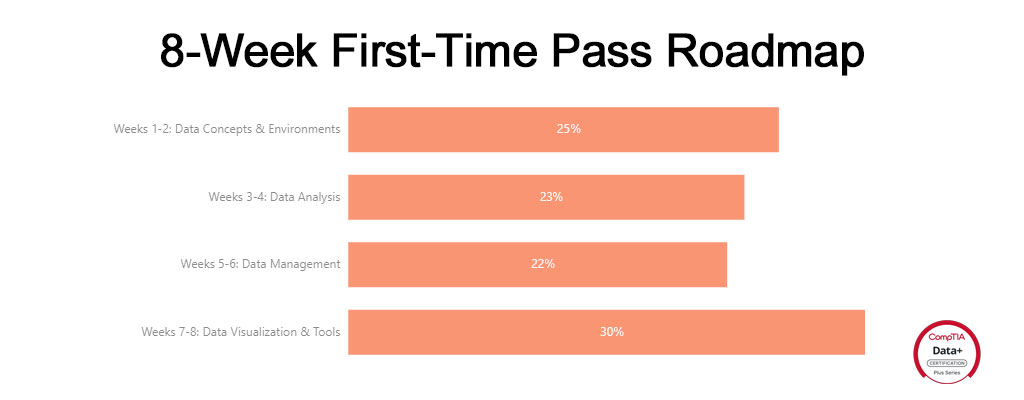
8-Week First-Time Pass Roadmap
Let’s dive into the 8-week study roadmap, broken down by the exam domains. By following this schedule, you’ll cover all topics efficiently while focusing on your weak spots.
Weeks 1-2: Data Concepts & Environments (25%)
Focus Areas: This is the foundation of your study plan. Start by understanding data types, data structures, file formats, and databases. Also, learn about different data sources—like APIs, logs, and cloud storage systems.
Pro Tip: While this section is foundational, don’t skip it! Some students rush through the basics and struggle with later, more advanced topics. “Understanding cloud storage, databases, and infrastructure will give you the tools to tackle more complex exam sections.”
Resources:
Google Sheets for basic data organization.
SQL basics for working with relational data.
Weeks 3-4: Data Analysis (23%)
Focus Areas: Now it’s time to dive into data analysis. This includes statistical methods, data cleaning, and working with SQL queries. Understanding how to work with data visualization tools is also crucial.
What Students Often Miss: Many candidates think they can skip practice with SQL queries or overlook data exploration. This section requires hands-on practice, so make sure you’re comfortable with querying, filtering, and analyzing real data.
Pro Tip: Use Google Sheets to start practicing simple queries. Once you’re comfortable, move on to SQLite or Power BI for deeper analysis.
Weeks 5-6: Data Management (22%)
Focus Areas: This section focuses on data governance, data security, and quality assurance. Learn about data integrity, compliance, access control, and data encryption.
What Most Students Miss: Many students overlook the importance of data privacy and compliance, which are critical parts of data management. Make sure you understand data lineage and retention policies.
Pro Tip: Practice data governance in Power BI by managing access to data and using version control.
Weeks 7-8: Data Visualization & Tools (30%)
Focus Areas: The final section is all about creating data visualizations and understanding the tools necessary for effective reporting. This is where you will spend most of your time practicing Power BI for dashboard creation and SQL for advanced queries.
What Students Struggle With: PBQs (Performance-Based Questions) are a significant part of this section, requiring you to create visual reports or troubleshoot issues with real-world datasets.
Pro Tip: Time management is crucial here. Allocate 20 minutes per PBQ during practice exams. Don’t overthink small details—focus on the bigger picture and your approach to problem-solving.
Best Resources for DA0-002 Preparation
Here’s a comparison of tools and resources that I highly recommend for DA0-002 preparation.
Resource
Type
Pros
Cons
Google Sheets
Free
Simple for basic analysis
Lacks advanced features
SQLite
Free
Excellent for DB practice
Steeper learning curve
Power BI Desktop
Free
Easy for visualizations and dashboards
Limited tutorials for beginners
Leads4Pass DA0-002
Paid
Targeted practice questions
Can be overwhelming with too many questions
Pro Tip: Leads4Pass has been especially helpful for my students in the final stages of preparation. It’s perfect for exam-style practice.
PBQ Strategies & Exam Day Tips
PBQs are the most challenging part of the DA0-002 exam. Here are some strategies to help you succeed:
Strategy #1: Approach each PBQ methodically. First, analyze the problem, then clean and format the data before diving into the visualization.
Strategy #2: Manage your time wisely. 20 minutes per PBQ should be enough to complete the task thoroughly.
Pro Tip: Don’t rush! Stay calm and take your time to understand each dataset before starting the analysis.
Common Pitfalls and How to Avoid Them
Skipping Fundamentals: Trying to jump into data analysis before understanding basic concepts will cause trouble later.
Fix: Follow the study roadmap and don’t skip foundational topics like data structures and data sources.
Over-Relying on Practice Tests: While practice tests are important, they won’t help you if you don’t understand the theory behind the tools and techniques.
Fix: Balance practice with theoretical study to reinforce your understanding.
Ignoring PBQs: Many students don’t dedicate enough time to PBQs.
Fix: Practice PBQs regularly and ensure you can complete them within the allotted time.
Why This Roadmap Leads to Real Career Wins
The DA0-002 certification isn’t just a piece of paper—it’s your ticket to data-related jobs and career advancement. By mastering the skills required for this exam, you’ll be better equipped to work with industry-standard tools like Power BI and SQL, making you highly marketable to potential employers.
“Take John, for example. He passed the DA0-002 after 7 weeks of preparation and immediately started his role as a data analyst. His work with SQL and Power BI opened doors to new opportunities.”
FAQ
How much time should I spend preparing for DA0-002?
Most candidates need around 6-8 weeks. Stay consistent and follow the roadmap.
What’s the best resource for PBQ practice?
Leads4Pass offers targeted practice tests that closely mirror the real exam.
Can I skip the Data Management section?
Absolutely not! This section is critical for understanding data integrity and compliance.
How can I get better at Power BI?
Practice with real-world datasets and build dashboards. There are plenty of beginner tutorials online.
Do I need to memorize SQL for DA0-002?
Yes! You need a strong understanding of SQL queries to pass the data analysis section.
In 2026, breaking into IT isn’t about knowing everything—it’s about proving you understand how technology fits together. That’s exactly where CompTIA Tech+ (FC0-U71) comes in. It’s not just a beginner cert—it’s a signal that you’re ready to think in systems, not just memorize tools. With AI, automation, and digital workflows reshaping entry-level roles, Tech+ is quietly becoming the new baseline for tech literacy, replacing older assumptions around ITF+.
🔍 What CompTIA Tech+ Really Represents (Not Just the Official Definition)
Beyond the syllabus
At first glance, CompTIA Tech+ (FC0-U71) looks like a standard entry-level certification. The official description emphasizes foundational skills—hardware, software, networking, security—but that barely scratches the surface.
What’s actually happening here is more subtle. Tech+ is designed as a decision-making certification, not just a knowledge checkpoint. It tests whether you can interpret technology, not just recognize it. For example, understanding cloud computing isn’t about defining it—it’s about knowing when it’s appropriate and why it matters in a workflow.
In practical terms, Tech+ teaches you to think like someone who can navigate complexity. That’s critical today because modern IT environments are no longer siloed. Even entry-level roles now touch cloud services, automation tools, and AI-assisted systems. The certification reflects that shift by blending concepts like data, security, and software logic into one unified framework.
Role in modern IT literacy
Here’s the uncomfortable truth: traditional “basic IT knowledge” is no longer enough. In 2026, even non-technical roles interact with APIs, dashboards, automation tools, or AI copilots. Tech+ sits right at that intersection.
Instead of preparing you for a specific job, it prepares you for how technology behaves in real environments. Think of it as learning the grammar of IT before writing sentences. That’s why CompTIA positions it as a pre-career certification—it helps candidates decide whether IT is the right path before committing deeper.
⚖️ Tech+ vs ITF+ vs A+: Where It Actually Fits
Key differences
The confusion between Tech+, ITF+, and A+ is real—and understandable. Tech+ essentially replaces ITF+, but with a more modern structure aligned to current tech trends.
A+, on the other hand, is not a replacement—it’s a progression.
This positioning matters because employers don’t evaluate these equally. Tech+ signals potential, while A+ signals capability.
🎯 Who Should (and Should NOT) Take FC0-U71
Ideal candidates
Tech+ works best for people at a very specific stage:
Career changers testing the waters
Students unsure about IT specialization
Non-technical professionals moving into tech-adjacent roles
Beginners with zero structured IT knowledge
If you’re asking, “Is IT even for me?”—this certification answers that question efficiently.
Who should skip it
This is where being honest matters. Tech+ is not for everyone.
Skip it if you:
Already understand networking basics, OS concepts, and security fundamentals
Have hands-on experience (even informally)
Plan to go straight into IT support roles
In those cases, going directly to A+ saves time and delivers more ROI. Tech+ becomes redundant because its value lies in orientation, not specialization.
📊 Exam Difficulty: What Makes FC0-U71 Easier — and What Doesn’t
Domains explained
The exam is structured across six domains, including IT concepts, infrastructure, software, databases, and security.
Here’s the catch—it’s broad, not deep.
You won’t configure networks
You won’t write production code
You won’t deploy security systems
Instead, you’ll understand how they work together.
Real difficulty expectations
On paper, the exam looks easy:
~70 questions
60 minutes
Passing score: 650/900
But difficulty isn’t about complexity—it’s about context switching.
You might jump from:
Binary systems →
Cloud computing →
Security concepts →
Databases
That mental switching is what catches people off guard. The exam rewards conceptual clarity, not memorization.
Understanding concepts, not memorizing definitions
Linking topics together (e.g., security + networking + data)
Practicing scenario-based thinking
Instead of asking “What is this?”, ask “When would I use this?”
Tools and resources
The most effective preparation blends official materials with practical testing tools. CompTIA’s own learning resources provide structure, but practice exams sharpen decision-making.
Each step increases specialization and job readiness.
Job role alignment
Here’s how that translates into real roles:
Tech+ → Exploration, internships, admin support
A+ → Help desk, IT support specialist
Network+ → Network technician, junior admin
Security+ → Security analyst, SOC roles
This pathway reflects how skills stack—not just certifications.
🌐 Industry Relevance in 2026
AI and automation impact
AI hasn’t reduced the need for entry-level IT—it’s changed it.
Now, entry-level professionals are expected to:
Understand AI-assisted tools
Interpret system outputs
Manage automated workflows
Tech+ directly reflects this shift by including exposure to AI concepts and modern technologies.
Is Tech+ future-proof?
Here’s the honest answer: Tech+ isn’t future-proof by itself—but it doesn’t need to be.
Its value lies in:
Building adaptable thinking
Creating a mental framework for learning
In a world where tools change constantly, that foundation matters more than specific technical skills.
Conclusion
Tech+ is not about proving you’re technical—it’s about proving you’re ready to become technical. That distinction is what makes it relevant in 2026. It filters out guesswork and gives you clarity: whether to move forward in IT—or pivot before investing deeper.
FAQs
1. Is CompTIA Tech+ worth it in 2026?
Yes, but only if you’re at the exploration stage. It’s valuable for understanding IT, not for landing technical jobs directly.
2. Is Tech+ replacing ITF+?
Yes. Tech+ is the updated version with broader and more modern coverage aligned with today’s technology landscape.
3. How long does it take to prepare for FC0-U71?
Most candidates prepare in 2–4 weeks, depending on prior exposure to technology concepts.
4. Can I skip Tech+ and go straight to A+?
Absolutely. If you already understand basic IT concepts, skipping Tech+ is often the better choice.
5. Does Tech+ expire?
No, it is considered a lifetime certification, unlike many higher-level CompTIA certifications.
If you were originally preparing for XK0-005 and suddenly realized it’s retired, landing on XK0-006 feels like someone moved the goalpost overnight. I’ve had multiple learners tell me the same thing: “Now there’s automation, containers, even AI… do I need to relearn everything?”
That reaction is completely normal. The biggest problem right now isn’t even the exam—it’s the fragmented learning resources. Some courses still follow 005, others partially updated, and Reddit threads often mix both versions without context.
The anxiety usually comes from seeing new buzzwords stacked into the objectives. It makes the exam look like a full DevOps certification. But once you break it down properly, the picture becomes much clearer—and a lot less intimidating.
The Good News Most People Miss
Here’s the part almost nobody emphasizes enough: roughly 70% of XK0-005 knowledge is still directly usable in XK0-006.
Core Linux hasn’t changed:
File systems
Permissions
Process management
Networking basics
What has changed is context.
Instead of asking “what does this command do,” XK0-006 leans toward: 👉 “How does this apply in a modern Linux environment?”
Once you shift your mindset from memorization → application, the transition becomes much smoother.
My Experience with Recent XK0-006 Candidates (Reality Check)
Since XK0-006 (Linux+ V8) is still relatively new, most insights right now come from recent candidate experiences, early exam feedback, and direct transitions from late-stage XK0-005 preparation.
What I have done over the past few months is:
Help a small group of candidates transition from late-stage XK0-005 prep
Analyze recent Reddit pass/fail threads
Compare real exam feedback with official objectives
Across the candidates I’ve guided and discussions I’ve had with a DevOps engineer (RHCSA-certified), one pattern is already very clear:
👉 People who pass treat XK0-006 as a practical exam, not a theory test.
And the ones who fail? They usually over-read and under-practice.
XK0-006 Exam Objectives Breakdown (Accurate 2026 Data)
This is where most guides stay surface-level—but this is exactly where your strategy should change.
1. System Management dropped (32% → 23%) This doesn’t mean it’s less important. It means CompTIA assumes you already know it. Expect fewer direct questions, more embedded scenarios.
2. New Domain: Services & User Management (20%) This is one of the most important additions. Instead of scattered topics, it’s now structured. In practice, you’ll see:
systemd service handling
user/group management in real scenarios
permission-related troubleshooting
3. Automation remains significant (17%) Even though the percentage looks similar, the depth changed. It now includes:
Containers
Config management awareness
Version control concepts
4. Troubleshooting still dominates (22%) This is huge. It confirms the exam is still scenario-heavy. If you can’t debug under pressure, you’ll struggle.
Deep Dive into New Topics (What Actually Shows Up)
Containers (Docker & Podman — What You Really Need)
This is where most people overreact.
From recent candidate feedback:
Basic container lifecycle commands show up
Some PBQs may involve identifying issues
No deep orchestration (no Kubernetes-level complexity)
A candidate I spoke with said:
“I expected Docker to be brutal. It was actually very basic—more like awareness + simple usage.”
That matches everything I’ve seen so far.
Automation & Scripting (Where You Should Focus)
This section is more about understanding workflows than coding expertise.
You should be comfortable with:
Bash scripting basics
Reading simple automation logic
Understanding config management concepts
A DevOps engineer I discussed this with put it bluntly:
“If you can read a script and understand what it’s doing, you’re already ahead.”
That’s the level XK0-006 is targeting.
AI Best Practices (The Most Overhyped Section)
Let’s clear this up quickly.
Based on real feedback:
Usually 1–2 questions max
No coding
No deep ML concepts
It’s more about:
Responsible usage
Data awareness
When NOT to use AI
Honestly, I’ve yet to see anyone fail because of this section.
Hybrid Cloud Troubleshooting (The Sneaky One)
This is not labeled as a separate domain, but it shows up inside troubleshooting.
You might see:
Service failures across environments
Network misconfigurations
Permission issues in shared systems
This is where pure “textbook learners” get caught off guard.
Where Most Candidates Struggle (Recent Patterns)
After reviewing multiple recent exam experiences, a few consistent issues stand out:
Knowing commands but not applying them
Freezing during PBQs
Ignoring troubleshooting practice
Overstudying theory-heavy topics
One Reddit user summed it up perfectly:
“The exam wasn’t hard—I just wasn’t used to thinking through problems fast enough.”
That’s exactly it.
My Recommended 6–8 Week XK0-006 Study Plan (2026)
Weekly Breakdown
Week 1–2: Core Linux refresh (commands + system basics)
Week 3: Services, users, permissions
Week 4: Security + troubleshooting scenarios
Week 5: Containers + automation basics
Week 6: Practice + weak areas
Week 7–8: PBQs + full mock exams
Daily Study Structure
Keep it simple but consistent:
1–2 hours per day
60% hands-on
40% theory
If you’re not using a Linux environment daily, you’re leaving points on the table.
My Recommended Learning Stack
This is what I personally suggest based on what’s working right now:
Official objectives (baseline clarity)
Hands-on labs (critical)
Practice exams (gap detection)
Think of it as a loop: Learn → Apply → Break → Fix → Repeat
The key is balance. No single resource is enough on its own.
How to Practice PBQs Effectively
PBQs test one thing: can you actually use Linux?
Best approach:
Use a VM (VirtualBox or similar)
Break configurations intentionally
Fix them without notes
That uncomfortable feeling? That’s exactly what prepares you for the exam.
Final Thoughts from a Linux Admin
XK0-006 isn’t harder—it’s just more honest.
It reflects how Linux is actually used today:
Mixed environments
Automation
Real troubleshooting
If you lean into hands-on practice early, the exam becomes much more predictable.
Conclusion
The transition from XK0-005 to XK0-006 isn’t a reset—it’s an upgrade.
Most of what you already know still applies. The real difference is how you apply that knowledge in more practical, modern scenarios. XK0-006 rewards people who can do, not just remember.
If you start building a lab environment today—even something simple—you’ll notice progress within days. Commands stop feeling abstract, troubleshooting becomes more intuitive, and your confidence grows naturally with each session.
At the same time, don’t underestimate the value of targeted practice resources. Hands-on labs should be your foundation, but structured question banks—especially those focused on PBQs and weak areas—can make a noticeable difference in how quickly you improve. This is where tools like Leads4pass come in handy for many candidates, helping reinforce exam-style thinking alongside your daily lab work.
Stick with a consistent routine for 6–8 weeks, combine real command-line practice with focused review, and you won’t just pass—you’ll actually feel like someone who can handle Linux in real-world situations.
And honestly, that’s the part you’ll appreciate the most a few months from now.
FAQs
Is XK0-006 harder than XK0-005?
Not necessarily harder, but more practical and scenario-based.
How much time should I spend on AI topics?
A few hours is enough. Focus on understanding concepts, not depth.
Are PBQs really that important?
Yes. They are often the deciding factor in passing.
Can I pass without real lab practice?
Highly unlikely. Hands-on experience is essential.
What’s the fastest way to transition from XK0-005?
Focus on new areas (automation, containers, services) and practice daily in a Linux environment.
The CompTIA CySA+ exam (CS0-003) is a major milestone for cybersecurity professionals, SOC analysts, and IT professionals aiming to elevate their careers. While most study guides cover the basics, there are some key areas that they fail to address — areas that could make or break your success on exam day. In this guide, we’ll explore what you need to know to truly prepare for the CySA+ exam and avoid common pitfalls that many candidates fall into.
Why the CS0-003 Exam Is Harder Than Most People Expect
The CS0-003 exam isn’t just a memorization test — it’s a real-world assessment of your cybersecurity analysis skills. Most study guides focus on theoretical knowledge, but the exam requires you to think like a Security Operations Center (SOC) analyst. Here’s why the CS0-003 exam is more challenging than many anticipate:
Shift from Theory to Real-World Analysis
Unlike certifications such as Security+, the CySA+ exam requires you to demonstrate the ability to apply security knowledge in real-world scenarios. For example, you won’t just be asked to recall facts about network security. Instead, you will be required to analyze network logs and spot anomalies, a skill that reflects the day-to-day responsibilities of a SOC analyst.
SOC Workflow Thinking
SOC analysts work under pressure, analyzing threats in real-time. The CS0-003 exam evaluates your ability to perform similar tasks, such as identifying malicious activity from a variety of alerts, using security tools to track intruders, and responding to incidents swiftly. The exam doesn’t just test your knowledge — it tests your decision-making process in high-stakes situations.
PBQ Simulations
Performance-based questions (PBQs) are a hallmark of the CySA+ exam. These questions simulate real-world environments where you must use tools and tactics to solve problems, rather than simply recalling facts. You’ll face scenarios like interpreting SIEM (Security Information and Event Management) alerts or analyzing suspicious network traffic, which require critical thinking and analysis.
What the CySA+ CS0-003 Exam Actually Tests
The CS0-003 exam is divided into several domains, with each focusing on different aspects of security operations. Here’s a breakdown of what you’ll be tested on:
Domain
Weight
Security Operations
33%
Vulnerability Management
30%
Incident Response
20%
Reporting & Communication
17%
Why Security Operations Dominates the Exam
Security operations represent the core of the exam. As the largest domain, it accounts for 33% of the total exam weight. This domain emphasizes your ability to monitor, detect, and respond to security events. You’ll need to demonstrate expertise in using common SOC tools and processes to safeguard an organization’s network.
Exam Structure and Scenario-Based Questions
The exam uses a combination of multiple-choice and PBQ formats. The multiple-choice questions test your theoretical knowledge, while PBQs simulate practical scenarios that you would face in a SOC. This structure ensures that you’re not just familiar with security concepts, but also with how to apply them effectively under pressure.
The Biggest Mistake Most CS0-003 Study Guides Make
Many study guides make the mistake of focusing too much on terminology and memorization. While it’s essential to understand basic concepts, memorizing definitions won’t help you pass the exam. Here’s why:
The Exam Demands Detection Logic and Threat Investigation
The CySA+ exam goes beyond memorization. It tests your ability to apply security analysis skills, such as detecting threats, interpreting logs, and investigating suspicious activity. For instance, you might be asked to examine a SIEM alert and identify whether it’s a false positive or a legitimate threat. Understanding the logic behind detecting these events is far more valuable than memorizing terms.
SIEM Alerts and Network Traffic Analysis
The exam is designed to simulate real-world security monitoring. You might be asked to analyze logs from a SIEM tool or identify indicators of compromise in network traffic. These tasks require a deep understanding of the various tools used in a SOC and how to interpret the data they generate.
Performance-Based Questions: The Real Challenge
PBQs are arguably the most challenging part of the CS0-003 exam. While they might seem straightforward, they are designed to test your ability to think critically and act quickly under pressure. Here’s why they’re so difficult:
Log Analysis and Attack Investigation
PBQs often involve analyzing raw logs to determine the nature of an attack. For example, you might need to identify whether a suspicious pattern in network traffic is the result of a DDoS attack or an insider threat. To succeed, you must be familiar with attack vectors and how to spot the early signs of a breach.
Security Tool Configuration and Correlating Events
Another common PBQ scenario involves using tools to identify and correlate security events. You’ll need to demonstrate your knowledge of how different tools interact, as well as how to configure them to provide meaningful data for incident response.
Common PBQ Mistakes
One of the most common mistakes candidates make is treating PBQs like multiple-choice questions. Instead of analyzing the data and considering all possible solutions, many candidates rush to make a decision. This rush often leads to incorrect conclusions, which can severely impact their score.
How Successful Candidates Actually Prepare
To truly succeed on the CS0-003 exam, you need to adopt a different study strategy — one that focuses on developing your skills in a SOC environment. Here’s a three-step approach:
Step 1 — Learn SOC Workflows
Understanding how a SOC operates is critical for success. This includes knowledge of tools, workflows, and how analysts collaborate to detect and respond to threats. The exam tests your ability to think like a SOC analyst, so you need to be familiar with real-world scenarios.
Step 2 — Practice Scenario Analysis
Reading through theoretical materials isn’t enough. You need to practice applying your knowledge in real-world scenarios. This can involve using simulation tools, analyzing log files, and working through practice PBQs to build your problem-solving skills.
Step 3 — Use Realistic Practice Questions
Many candidates recommend using curated practice materials that closely mimic the actual exam. One resource that has been popular in the cybersecurity community is Leads4Pass, which offers practice exams designed to simulate the real-world CySA+ experience. These materials provide a more realistic sense of the types of questions you’ll encounter on the actual exam.
Recommended Learning Path for CySA+
If you’re serious about pursuing a career in cybersecurity, the CySA+ exam is an essential stepping stone. Here’s an example of a certification progression to help guide your learning:
Following this path ensures that you’re building a strong foundation before tackling more advanced certifications like SecurityX (An advanced cybersecurity certification for security architects and senior security engineers.).
Free CS0-003 Practice Questions (PDF)
To help you prepare, I’ve created a free set of CS0-003 practice questions in PDF format. Download the practice questions to test your readiness for the exam and get a feel for the types of questions you’ll face.
Final Thoughts: CS0-003 Is a Security Analyst Exam, Not a Memorization Test
In conclusion, the CS0-003 exam is designed to test your ability to think like a cybersecurity analyst. The exam evaluates your real-world security analysis skills, threat detection capabilities, and incident response thinking. It’s not a memorization test — it’s a hands-on evaluation of your practical knowledge and decision-making ability. To pass, you’ll need to understand SOC workflows, practice real-world scenarios, and develop the critical thinking required to respond to security incidents.
FAQs
How many questions are on the CS0-003 exam? The CS0-003 exam contains up to 85 questions, with a mix of multiple-choice and performance-based questions.
What is the passing score for the CySA+ exam? The passing score for the CS0-003 exam is 750 out of 900.
Are practice exams helpful for CySA+ preparation? Yes, but make sure you use realistic practice exams that simulate the actual test environment, including PBQs.
What tools do I need to be familiar with for the CS0-003 exam? Familiarity with SIEM tools, vulnerability management platforms, and incident response tools is essential for the exam.
I’m writing this as someone who’s been in networking long enough to see trends come and go. I’ve worked as a network engineer for over ten years, and between 2025 and 2026, I helped several people with zero IT background pass CompTIA Network+ (N10-009)—not as a theory exercise, but as a real career move.
Some switched careers. Some negotiated raises. One quietly did both.
I’m not here to hype. I’m here to share what actually worked.
Let Me Say It First: Is CompTIA Network+ Still Worth It in 2026?
Short answer: yes, if you use it correctly.
Long answer: I personally watched this certification create about a 20–25% salary jump for people who had no formal networking background before.
My Own Turning Point
Early in my career, I thought experience alone would carry me. It didn’t. The moment I added a vendor-neutral networking credential, interviews changed tone. Less “prove yourself,” more “tell me how you think.”
One was a warehouse supervisor, no IT degree, mid-30s. Passed in 32 days. Landed a junior network support role with a 22% pay increase.
Another was IT support for five years, stuck. Same exam. Same month. Negotiated a 25% raise internally.
Same exam. Different paths. Same outcome.
Do Network Jobs Still Exist in 2026? Or Did AI Take Them All?
People love this question. It sounds smart. It’s also misleading.
What Actually Changed
AI didn’t remove networking jobs. It removed repetitive guessing.
What grew instead:
Network monitoring
Cloud connectivity
Security-driven networking
Hybrid on-prem + SD-WAN environments
What Shrunk
Pure cable-pulling roles
“Click-only” configuration jobs
Why Networking Is Still the Invisible Backbone
Every AI workload, cloud service, and zero-trust model still depends on traffic moving correctly. When it doesn’t, humans fix it.
That hasn’t changed.
Salary Reality Check: Certified vs Non-Certified (2026 Data)
Based on early-2026 aggregated listings from Glassdoor and similar platforms:
Role
No Certification
Network+ Certified
IT Support
$48,000
$58,000
Junior Network Tech
$55,000
$68,000
Network Administrator
$72,000
$88,000
These aren’t promises. They’re leverage points.
Certification doesn’t guarantee money. It changes negotiation odds.
What Exactly Changed in Network+ N10-009
This version finally feels like real work.
Domain Weight
Networking Concepts – ~23%
Network Implementation – ~20%
Network Operations – ~19%
Network Security – ~14%
Network Troubleshooting – ~24%
Balanced. Practical. Less trivia.
Why N10-009 Matters
You’ll see:
More troubleshooting logic
More security context
Less memorization for memorization’s sake
Important: N10-009 is the only valid version in 2026. Retirement is expected in 2027, with no replacement announced yet.
Who This Exam Is Really For (And Who Should Skip It)
Good Fit
Career switchers with zero background
IT support professionals stuck on salary
Self-taught learners needing structure
Skip It If
You already design enterprise networks
You only want cloud architecture without fundamentals
My 30-Day Study Plan (Zero-Base, Copy-Paste Friendly)
Week
Focus
Week 1
Networking basics, OSI, IP addressing
Week 2
Switching, routing, wireless
Week 3
Security, operations, monitoring
Week 4
Troubleshooting, PBQs, full reviews
Daily time: 2–3 focused hours. No marathon sessions.
How I Used AI Without Fooling Myself
AI helped me think, not memorize.
Prompts I Actually Used
“Explain subnetting like I’m troubleshooting a ticket at work.”
“Create a failure scenario for VLAN misconfiguration.”
“Ask me five Network+-style troubleshooting questions.”
What AI Cannot Replace
Time under pressure
Pattern recognition
Mistake analysis
Use AI as a coach, not a shortcut.
Practice Exams: What Actually Helped
I ignored brain-dump-style questions.
I focused on:
Why an answer was wrong
What symptom led to that choice
I used multiple sources, including **one set of realistic practice questions from https://www.leads4pass.com/n10-009.html —not perfect, but useful when filtered carefully.
Five Domains People Lose Points On (And How I Remember Them)
Networking Concepts
Think traffic flow, not definitions.
Network Implementation
Visualize cables and ports physically.
Network Operations
Pretend you’re on call at 2 a.m.
Network Security
Assume everything is hostile until proven otherwise.
Network Troubleshooting
Symptoms first. Fixes last.
PBQs: Why They Feel Scary but Aren’t
PBQs test logic, not speed.
My rule:
Identify the goal
Eliminate distractions
Solve one connection at a time
Slow is smooth. Smooth is fast.
Exam Day: Zero-Mistake Strategy
Flag PBQs, don’t panic
Finish MCQs first
Return with calm focus
Eat. Sleep. Breathe. This isn’t hero work.
What Interviewers Ask After You Pass
Expect questions like:
“How would you troubleshoot packet loss?”
“Difference between VLAN and subnet?”
“Why does DNS fail even when ping works?”
“What’s your first step in a network outage?”
“Explain zero trust in simple terms.”
They’re testing thinking, not trivia.
Turning the Certificate Into Money (Fast)
Resume Example
“CompTIA Network+ (N10-009), hands-on troubleshooting of routing, switching, and network security scenarios.”
One Honest Sentence for You If You’re Still Hesitating
If you wait until you feel ready, you’ll wait forever.
Conclusion
CompTIA Network+ (N10-009) in 2026 isn’t magic. It’s a tool. Used properly, it creates confidence, structure, and leverage—especially for people starting from zero.
I’ve seen it work quietly, consistently, and without hype.
If you’re studying, share your progress. You’re closer than you think.
FAQs
1. Can I really pass Network+ in 30 days with no background? Yes, if you study daily and focus on understanding, not memorizing.
2. Is Network+ outdated because of cloud and AI? No. Cloud and AI increase networking complexity, not remove it.
3. Will employers still respect this cert in 2026? Yes, especially for entry-level and transitional roles.
4. Should I do Security+ first instead? Not without networking fundamentals. That’s a common mistake.
5. What’s the biggest reason people fail? Trying to rush without understanding how networks actually behave.
When I first started coaching people for CompTIA A+ 220-1201 (Core 1), something became obvious very quickly. Plenty of candidates knew the material, yet froze when questions felt like real incidents instead of classroom prompts. I saw the same thing when I sat for 220-1201 myself—especially in networking and troubleshooting scenarios where multiple answers looked “correct,” but only one matched how work actually gets done.
This version of Core 1 doesn’t reward surface-level familiarity. It tests whether you can think like the person responsible when something stops working and users are waiting.
That’s what this guide is about: closing that gap so you don’t just pass—you pass confidently.
Why CompTIA A+ Core 1 Still Decides Who Gets Hired
After more than a decade in IT support and training, I can say this clearly: CompTIA A+ Core 1 still shapes hiring decisions. Recruiters may not know every exam detail, but they trust what A+ represents—baseline competence, structured thinking, and readiness for real environments.
With A+ Core 1 V15, CompTIA leaned into:
Hybrid and remote work support
Practical networking judgment
Cloud awareness without vendor lock-in
Troubleshooting under limited access
If you want an entry-level IT role, this exam remains one of the most reliable ways to prove you’re ready.
220-1201 Core 1 V15: What the Exam Really Focuses On
Before studying anything, you need to understand the battlefield.
Exam Structure
Up to 90 questions
Multiple choice, drag-and-drop, and PBQs
90 minutes total testing time
Domain Weight Breakdown
Mobile Devices – 13%
Networking – 23%
Hardware – 25%
Virtualization & Cloud – 11%
Hardware & Network Troubleshooting – 28%
Key Changes From 220-1101
From a practical standpoint:
Networking carries more weight and realism
Remote diagnosis scenarios are common
Type 1 vs Type 2 hypervisors are clearly separated
Cloud concepts like shared infrastructure matter
The formal CompTIA troubleshooting steps are no longer isolated—but the logic behind them is everywhere
Roughly 87% overlaps with the previous version. The remaining portion is where preparation style makes the difference.
Hardware Combat Zone: Lessons Learned From Real Break-Fix Jobs
Hardware questions don’t test whether you’ve memorized specs. They test whether you recognize failure patterns.
In the real world, I rarely see hardware “die cleanly.” Instead, you’ll see:
Random shutdowns from failing power supplies
Systems booting only with certain RAM sticks
Drives that technically work but crawl under load
How You Should Train
Identify symptoms before causes
Learn what intermittent failure looks like
Understand what can be tested quickly onsite
If a question feels vague, that’s intentional. The exam wants your best diagnostic move, not a full repair plan.
Mobile Devices Under Pressure: What Fails in Real Life
Mobile device questions in 220-1201 reflect support tickets more than labs.
Common scenarios include:
Email not syncing on corporate phones
Battery complaints tied to usage patterns
Touch issues that aren’t display failures
Your advantage comes from separating:
Hardware faults
OS or app behavior
Policy or configuration limits
Once you do that, most wrong answers eliminate themselves.
Networking Labyrinth: The Hidden Problems That Kill Connections
Networking is where many confident candidates lose momentum.
The exam loves scenarios like:
Wi-Fi connected but no internet access
VPN connected with limited resource access
Devices working locally but failing remotely
You must be comfortable with:
Ports and protocols in context
Cable types and signal behavior
SOHO router logic
The key question to ask yourself: What would I check first if I couldn’t touch the device?
Virtualization & Cloud Demystified: Thinking Like the Exam Writer
This section feels intimidating until you simplify it.
Type 1 hypervisor: Runs directly on hardware
Type 2 hypervisor: Runs on top of an OS
Cloud questions usually test:
Resource sharing
Scalability
Responsibility boundaries
If you visualize cloud services as shared infrastructure rather than individual machines, the logic becomes clear.
Printers and Power: The Small Topics That Steal Big Points
Printers show up on the exam because they cause real-world pain.
Know how to recognize:
Fuser-related defects
Toner vs drum issues
Ink problems that mimic hardware failure
Power topics matter too:
Surge protectors vs UPS
Brownouts vs blackouts
These questions are straightforward if you’ve seen the symptoms before.
Fault Hunting in the Field: My On-the-Spot Diagnostic Framework
This is how I troubleshoot on the job—and how I approach PBQs:
Define the symptom precisely
Separate hardware from connectivity
Change only one variable
Observe results before acting again
This mindset aligns perfectly with how CompTIA frames scenarios.
Preparing the Way Technicians Actually Learn
Strong candidates don’t just read—they interact.
What works:
Explaining answers aloud
Sketching network paths
Labeling ports and components
Teaching concepts to someone else
If you can walk someone through a fix, you’re ready for the exam.
Hands-On Practice Without Expensive Gear
You don’t need enterprise equipment.
Useful practice setups:
An old PC for hardware swaps
Free virtualization tools
Your home router’s admin interface
Built-in Windows networking tools
Practical familiarity beats polished simulations.
Mistakes I See Strong Candidates Make Over and Over
These patterns show up constantly:
Fixing before diagnosing
Ignoring question context
Rushing through PBQs
Slow down just enough to align your thinking with the scenario.
Exam-Day Execution: Managing Time, Stress, and Judgment
For up-to-date, exam-aligned practice, I also used the 220-1201 exam dumps from Leads4Pass to reinforce networking and troubleshooting scenarios. 👉 https://www.leads4pass.com/220-1201.html
Use it to strengthen understanding—not as a shortcut.
What Comes After Core 1: Transitioning to Core 2
Once 220-1201 is done, momentum matters.
Core 2 (220-1202) shifts toward:
Operating systems
Security fundamentals
Software troubleshooting
If you want continuity, I’ve already mapped that transition in my CompTIA A+ 220-1202 Core 2 V15 guide, focusing on what changes mentally between the exams.
From Certification to Career Momentum
Passing CompTIA A+ reshaped my career. It validated my experience and opened doors that stayed closed before. More importantly, it sharpened how I approach problems under pressure.
You can reach that point too—with the right preparation and mindset.
Conclusion
CompTIA A+ 220-1201 (Core 1) rewards practical judgment, structured thinking, and situational awareness. When you prepare with real-world logic instead of surface familiarity, the exam becomes predictable—and passing on your first attempt becomes realistic. Stay focused, practice intentionally, and trust the process.
FAQs
1. Is CompTIA A+ 220-1201 harder than 220-1101? It’s more realistic, especially in networking and remote support scenarios.
2. How long should preparation take? Most candidates succeed with 6–10 weeks of focused study.
3. Are PBQs critical? Yes. They heavily influence your final score.
4. Do I need job experience to pass? No, but hands-on practice significantly improves performance.
5. Should I take Core 1 before Core 2? Yes. Many candidates find that order more manageable.
If you’re starting your IT career in 2025, the CompTIA A+ 220-1202 (Core 2 V15) certification is your best foundation. It’s globally recognized as the entry-level standard for IT professionals, proving your ability to troubleshoot, secure, and manage diverse operating systems — from Windows to Linux to mobile OS.
Whether you’re aiming to become a Help Desk Technician, IT Support Specialist, or Field Engineer, this certification opens real-world opportunities in both enterprise and remote tech support environments.
Core 1 focuses on hardware, networking, and mobile device fundamentals, while Core 2 emphasizes operating systems, security, software troubleshooting, and operational procedures.
You must pass both exams to become officially A+ certified.
This dual-exam structure ensures you gain not only theoretical knowledge but also the practical, cross-platform skills needed in real-world IT environments.
Understanding the CompTIA A+ 220-1202 Exam Structure
Exam Overview
Exam code: 220-1202 (Core 2 V15)
Version released: 2025
Question types: Multiple-choice and performance-based (PBQs)
Duration: 90 minutes
Passing score: 700 out of 900
Languages available: English, Japanese, Portuguese, Spanish, Thai, and more.
In 2025, CompTIA A+ remains the most in-demand certification for IT support. Employers still treat it as a baseline qualification for entry-level tech roles.
According to the 2025 CompTIA Workforce Study, certified professionals earn 15–25% more and have a 40% higher promotion rate in the first year.
Compared with Microsoft Certified: Fundamentals or Cisco CCST, the A+ covers a broader range of practical IT troubleshooting and operating system management — perfect for those entering IT without a degree.
What’s Covered in the A+ 220-1202 Exam
Operating Systems (28%)
Learn to install, configure, and maintain Windows, macOS, Linux, and mobile OS. You’ll master file system structures, OS upgrades, and built-in tools such as Task Manager, Command Prompt, and Disk Management.
👉 Pro Tip: Practice building virtual labs using VMware or VirtualBox to simulate installations.
Security (28%)
Security knowledge is more critical than ever. You’ll study:
In today’s hybrid work environments, these skills are directly applicable to remote IT support.
Software Troubleshooting (23%)
You’ll be tested on diagnosing problems with:
Operating systems – boot errors, driver issues
Mobile devices – connectivity or performance failures
Security issues – malware, unauthorized access
Candidates often underestimate this section. But PBQs frequently simulate real helpdesk scenarios where timing and logical flow matter.
Operational Procedures (21%)
This domain focuses on soft skills and professional best practices:
Documentation standards
Communication and safety protocols
Backup and disaster recovery
These are essential for long-term career success and client satisfaction — not just exam points.
10 Key Tips to Pass CompTIA A+ 220-1202 on Your First Try
1. Start with the Official Exam Objectives
Download CompTIA’s free Core 2 V15 objectives. Read them line by line — they define every question type and expected knowledge scope.
2. Use Verified Study Materials
Begin with CompTIA CertMaster Learn and supplement it with trusted third-party platforms like Leads4Pass 220-1202 (https://www.leads4pass.com/220-1202.html). These resources align with the latest 2025 version, providing updated dumps and PBQs.
3. Set Up Your Own Virtual Lab
Hands-on practice beats memorization. Use virtual machines to install and troubleshoot different operating systems. Create scenarios that mimic real support tickets — for example, fixing boot loops or corrupted user profiles.
4. Practice with Performance-Based Questions
CompTIA increasingly emphasizes PBQs — interactive simulations where you must apply knowledge, not just recall it. Sites like Leads4Pass include realistic PBQs modeled after the 2025 format.
5. Plan a Study Schedule
A structured plan increases your pass probability. Example:
Weeks 1–2: Operating Systems basics
Weeks 3–4: Security deep dive
Weeks 5–6: Software troubleshooting labs
Weeks 7–8: Practice exams & revision
Study 1–2 hours per day instead of cramming the night before.
6. Join Online Study Groups
Communities like Reddit’s r/CompTIA, Discord servers, and LinkedIn study groups help you learn from others’ experiences. Real candidates share test feedback and quick revision notes.
7. Track Your Weaknesses
After every mock test, analyze your weakest domain. For example, if you keep missing malware prevention or Linux commands, focus exclusively there for a week.
8. Learn with Real IT Scenarios
Work on small projects — fix your home network, reinstall OS, or manage updates for friends. Employers value hands-on exposure even before you’re certified.
9. Use Quality Practice Tests
Use platforms with updated question banks. Leads4Pass 220-1202 Practice Tests include verified and regularly refreshed questions aligned with official objectives.
These practice sets simulate real exam pressure and time management.
10. Prepare Mentally for Exam Day
Sleep well the night before. During the test:
Don’t spend more than 90 seconds on one question.
Mark difficult ones and return later.
Double-check performance-based questions last.
Confidence is your greatest tool on exam day.
How Hard Is the CompTIA A+ 220-1202 Exam?
The 220-1202 is moderately difficult, especially due to its PBQs. Candidates with structured study plans and practice exams report 90–95% first-time pass rates.
How Long Should You Study?
For beginners: 10–12 weeks. For IT professionals with prior experience: 5–6 weeks. Follow a consistent schedule with milestone tracking (modules completed, mock scores).
Real-World Benefits of Earning CompTIA A+
After certification, you can work as:
Help Desk Technician
Desktop Support Analyst
IT Field Engineer
Average U.S. salary in 2025: $58,000–$65,000 annually, with higher rates in cybersecurity-adjacent roles.
Is CompTIA A+ Still Worth It in 2025?
Absolutely. The demand for skilled IT support specialists continues to rise with remote and hybrid work models. A+ remains a prerequisite for advanced CompTIA paths like Network+, Security+, or CySA+.
Common Myths About A+
Myth 1: “A+ is too basic.” → False. It covers advanced OS and security topics, including Linux permissions and mobile integration.
Myth 2: “You need a degree.” → Many tech professionals start with A+ and move directly into IT support roles.
Myth 3: “It’s outdated.” → The Core 2 V15 update ensures relevance for modern IT infrastructures.
Exam-Day Strategy Checklist
✅ Arrive 30 minutes early
✅ Review key commands (ipconfig, ping, chkdsk)
✅ Read PBQs carefully before answering
✅ Double-check all flagged questions
Conclusion — Your Road to IT Success Starts Here
Passing the CompTIA A+ 220-1202 exam is more than just earning a badge — it’s proof that you can troubleshoot, secure, and manage today’s complex IT systems.
If you prepare smartly with structured study, community support, and resources like Leads4Pass 220-1202, you can confidently pass on your first try and step into your IT career with momentum.
FAQs
1. What’s new in CompTIA A+ 220-1202 compared to 220-1102? It now includes macOS, Linux, and mobile OS, plus updated wireless and encryption protocols.
2. How long should I study before taking the exam? Plan 8–12 weeks depending on your experience and available time.
3. What jobs can I get with A+? Help Desk Technician, Support Specialist, Field Engineer, and IT Analyst.
5. Is A+ still worth it in 2025? Yes — it’s the foundation for most IT certifications and an entry point into stable tech careers.
6.How many exams do I need to pass to get CompTIA A+ certified?
You must pass two exams — 220-1201 (Core 1) and 220-1202 (Core 2). Core 1 covers hardware and networking basics, while Core 2 focuses on operating systems, security, and troubleshooting. Once both exams are passed, you’ll officially earn your CompTIA A+ certification.
The IT industry continues to grow at an unprecedented pace, with demand for skilled professionals driving career opportunities worldwide. CompTIA certifications stand out as a trusted benchmark for validating technical expertise, offering a clear path for beginners and seasoned pros alike. This article ranks the top 10 CompTIA certification exams for 2025 based on industry relevance, job demand, and earning potential. Beyond a simple list, it provides actionable insights
Why CompTIA Certifications Matter
CompTIA (Computing Technology Industry Association) certifications are vendor-neutral, meaning they focus on foundational and advanced IT skills applicable across multiple platforms—unlike vendor-specific credentials like Cisco’s CCNA or Microsoft’s Azure certifications. This versatility makes them invaluable for professionals navigating a diverse tech landscape. According to CompTIA’s own data, over 2.5 million certifications have been awarded globally, a testament to their authority and trustworthiness in the field.
For readers, the real question isn’t “Why certify?” but “Which certification fits my goals?” This article answers that by breaking down the top 10 exams, their challenges, and how they address career-specific needs—whether you’re stuck in a low-paying job, seeking a promotion, or breaking into IT without a degree.
Ranking the Top 10 CompTIA Certification Exams
Below is a detailed ranking of the top 10 CompTIA certification exams for 2025, based on job market trends, salary data, and practical utility. Each section includes exam details, target audience, difficulty, and real-world applications.
1.CompTIA A+ (Core 1: 220-1101, Core 2: 220-1102)
Overview: The entry-level gold standard for IT support roles, covering hardware, software, networking, and troubleshooting.
Difficulty: Moderate (requires 9-12 months of experience).
Cost: $246 per exam (total $492).
Jobs: Help Desk Technician, IT Support Specialist.
Salary: $45,000–$65,000 annually (U.S. median, per CompTIA).
Why It’s Top: It’s the most recognized starting point, solving the “no experience, no job” dilemma for beginners.
Practical Value: A+ equips you with skills to fix PCs, configure mobile devices, and troubleshoot networks—tasks employers expect on day one.
2.CompTIA Network+ (N10-008 -> N10-009)
Overview: Focuses on networking concepts, infrastructure, and operations.
Difficulty: Moderate to High (builds on A+ knowledge).
Cost: $358.
Jobs: Network Administrator, Systems Engineer.
Salary: $60,000–$85,000.
Why It’s Top: Networks+ are the backbone of IT; this cert proves you can manage them.
Practical Value: Learn to set up routers, troubleshoot connectivity, and secure networks—skills in demand as remote work grows.
3.CompTIA Security+ (SY0-701)
Overview: Covers cybersecurity fundamentals, threat detection, and risk management.
Difficulty: High (requires networking basics).
Cost: $392.
Jobs: Security Analyst, IT Auditor.
Salary: $75,000–$100,000.
Why It’s Top: Cybersecurity is a critical need; this cert opens high-paying doors.
Practical Value: Master encryption, incident response, and compliance—skills that protect businesses from costly breaches.
Overview: Advanced security for enterprise environments.
Difficulty: Expert (10+ years recommended).
Cost: $494.
Jobs: Security Architect, Senior Analyst.
Salary: $100,000–$140,000.
Why It’s Top: The pinnacle of CompTIA’s security track.
Practical Value: Design secure systems at scale—expertise that commands top pay.
8.CompTIA Server+ (SK0-005)
Overview: Covers server hardware, software, and management.
Difficulty: Moderate-High.
Cost: $358.
Jobs: Server Administrator, Data Center Technician.
Salary: $65,000–$90,000.
Why It’s Top: Servers power everything; this cert keeps them running.
Practical Value: Manage physical and virtual servers—skills vital for data-driven firms.
9.CompTIA Linux+ (XK0-005)
Overview: Focuses on Linux system administration and security.
Difficulty: High (Linux experience needed).
Cost: $358.
Jobs: Linux Administrator, DevOps Engineer.
Salary: $70,000–$95,000.
Why It’s Top: Linux+ powers most servers and clouds.
Practical Value: Administer open-source systems—key for cost-conscious employers.
10.CompTIA Project+ (PK0-005)
Overview: Project management tailored for IT environments.
Difficulty: Moderate.
Cost: $358.
Jobs: IT Project Manager, Coordinator.
Salary: $70,000–$100,000.
Why It’s Top: Bridges tech skills with leadership.
Practical Value: Lead IT projects effectively—skills that boost team success.
How to Prepare for CompTIA Exams?
Preparing for a CompTIA exam can feel overwhelming—especially if you’re balancing work, family, or financial constraints. Here’s how to tackle common challenges with proven strategies:
1.Time Management: Study 2-3 hours daily for 8-12 weeks. Use tools like Pomodoro for focus.
2.Cost Concerns: Leverage free resources like Professor Messer’s videos alongside official CompTIA study guides.
3.Hands-On Practice: Set up a home lab with VirtualBox or use CompTIA Labs.
4.Exam Anxiety: Take practice tests on Leads4Pass to build confidence.
Conclusion
CompTIA certifications offer a structured path to IT success, addressing real-world needs like job security, skill validation, and career growth. From A+ to CASP+, Each exam addresses specific needs—whether it’s breaking into IT, mastering networks, or securing systems. Choose based on your experience and goals, and use the strategies above to pass with confidence. For more details, visit CompTIA’s official site.
Key Questions Candidates Care About
1.Are CompTIA Exams Too Hard for Beginners?
Answer: Not if you prepare. A+ is beginner-friendly with a 70% pass rate if you study 8–12 weeks using CompTIA CertMaster. Higher-level exams like Security+ need networking basics but are manageable with effort. Start small and build up.
2.What Happens If I Fail a CompTIA Exam?
You can retake it—no limit on attempts. Wait 14 days if it’s your second try (CompTIA policy). Costs add up ($358–$494 per exam), so review weak areas with practice tests before retrying.
3.Are CompTIA Certs Recognized Worldwide?
Yes, they’re globally accepted. Over 2.5 million certifications awarded across 147 countries (CompTIA data). Companies like IBM and governments like the U.S. DoD value them, making them portable for international careers.
4.Can CompTIA Certs Replace a College Degree?
Often, yes. Employers like Dell and HP hire A+ or Security+ holders without degrees for roles paying $45,000–$100,000 (BLS data). Pair certs with experience—degrees help, but certs prove skills faster.
5.Do CompTIA Certifications Expire?
Most expire after 3 years (e.g., Security+, Network+), but A+ is lifelong. Renew by earning CEUs via training or higher certs (CompTIA CE Program). Plan ahead—expiration can affect job eligibility.
6.What’s the Format of CompTIA Exams Like?
Exams mix multiple-choice and performance-based questions (PBQs). A+ has 90 questions in 90 minutes, including PBQs like configuring a firewall (CompTIA A+ details). Practice PBQs online to get comfortable—speed and hands-on skills are key.
CV0-004 exam dumps meet all preparation requirements for the actual CompTIA Cloud+ exam, providing real-life scenario exam questions and answers.
CompTIA Cloud+ (CV0-004) Verification Candidate:
Understand cloud architecture and design concepts.
Implement and maintain a secure cloud environment.
Successfully provision and configure cloud resources.
Demonstrate the ability to manage operations throughout the cloud environment life cycle using observability, scaling, and automation.
Understand fundamental DevOps concepts related to deployment and integration.
Troubleshoot common issues related to cloud management.
Use CV0-004 exam dump, which contains 285 latest exam questions and answers, accurately hits all core exam questions, reading list:
Single & multiple choice
277 Q&As
Hotspot
2 Q&As
Simulation labs
6 Q&As
Update time
Feb 2025
The actual CompTIA Cloud+ (CV0-004) exam will change over time. But no matter what happens, Leads4Pass can always provide the latest CV0-004 exam dumps as soon as possible, identify the latest materials, and download the latest materials to help you pass easily.
Next, you can verify a free CV0-004 exam question online.
A cloud engineer wants to replace the current on-premises. unstructured data storage with a solution in the cloud. The new solution needs to be cost-effective and highly scalable. Which of the following types of storage would be best to use?
A. File
B. Block
C. Object
D. SAN
Correct Answer: C
Object storage is ideal for cost-effective and highly scalable unstructured data. It allows for the storage of massive amounts of unstructured data in a flat namespace and is not constrained by the rigid structures of file or block storage. Object
storage is highly durable and designed for high levels of scalability and accessibility.
References: The suitability of object storage for unstructured data and scalability is a part of cloud storage technologies covered in CompTIA Cloud+ materials.
Question 2:
A company needs to deploy its own code directly in the cloud without provisioning additional infrastructure. Which of the following is the best cloud service model for the company to use?
A. PaaS
B. SaaS
C. laaS
D. XaaS
Correct Answer: A
Platform as a Service (PaaS) is the best cloud service model for deploying code directly in the cloud without provisioning additional infrastructure. PaaS provides a platform allowing customers to develop, run, and manage applications without the complexity of building and maintaining the infrastructure.References: The PaaS model and its benefits for application deployment are covered under the Cloud Concepts domain in the CompTIA Cloud+ certification.
Question 3:
Which of the following do developers use to keep track of changes made during software development projects?
A. Code drifting
B. Code control
C. Code testing
D. Code versioning
Correct Answer: D
Developers use code versioning to keep track of changes made during software development projects. It is a system that records changes to a file or set of files over time so that specific versions can be recalled later. References: CompTIA Cloud+ Study Guide (V0-004) – Chapter on Software Development in Cloud Environments
Question 4:
A cloud developer is creating a static website that customers will be accessing globally. Which of the following services will help reduce latency?
A. VPC
B. Application load balancer
C. CDN
D. API gateway
Correct Answer: C
A Content Delivery Network (CDN) is the service that will help reduce latency for a static website accessed globally. CDNs distribute content across multiple geographically dispersed servers, allowing users to connect to a server that is closer to them, thereby reducing the time it takes to load the website.
References: The use of CDNs is a common practice to enhance global access and improve user experience, as covered under Cloud Concepts in the CompTIA Cloud+ certification.
Question 5:
A company has applications that need to remain available in the event of the data center being unavailable. The company\’s cloud architect needs to find a solution to maintain business continuity.
Which of following should the company implement?
A. A DR solution for the application between different data centers
B. An off-site backup solution with a third-party vendor
C. laC techniques to recreate the system at a new provider
D. An HA solution for the application inside the data center
Correct Answer: A
A disaster recovery (DR) solution is a set of policies, procedures, and tools that enable an organization to restore or continue its critical functions in the event of a natural or human-induced disaster. A DR solution for the application between different data centers means that the application is replicated or backed up to another location that is geographically separated from the primary data center. This way, if the primary data center becomes unavailable due to a power outage,
fire, flood, cyberattack, or any other cause, the application can be switched over to the secondary data center and resume its operations with minimal downtime and data loss. This solution ensures business continuity and high availability for the application and its users.
References: CompTIA Cloud+ CV0- 003 Study Guide, Chapter 5: Maintaining a Cloud Environment, page 221-222; Disaster recovery planning guide.
Question 6:
SIMULATION
You are a cloud engineer working for a cloud service provider that is responsible for an IaaS offering.
Your customer, who creates VMs and manages virtual storage, has noticed I/O bandwidth issues and low IOPS (under 9000).
Your manager wants you to verify the proper storage configuration as dictated by your service level agreement (SLA).
The SLA specifies:
1.
Each SFP on the hypervisor host must be set to the maximum link speed allowed by the SAN array. . All SAN array disk groups must be configured in a RAID 5.
2.
The SAN array must be fully configured for redundant fabric paths. . IOPS should not fall below 14000 INSTRUCTIONS Click on each service processor to review the displayed information. Then click on the drop-down menus to change the settings of each device as necessary to conform to the SLA requirements.
A. See the explanation for complete solution.
B. PlaceHolder
C. PlaceHolder
D. PlaceHolder
Correct Answer: A
Based on the SLA requirements and the information provided in the diagram:
For the Hypervisor:
Slot A fiber channel card:
Port 1 link speed should be set to 16 Gbps since it\’s connected to Fabric switch A which supports 16 Gbps.
Port 2 link speed should be set to 8 Gbps because it\’s connected to Fabric switch B which supports up to 8 Gbps.
Slot B fiber channel card:
Port 1 link speed should be set to 16 Gbps since it\’s connected to Fabric switch A which supports 16 Gbps.
Port 2 link speed should be set to 8 Gbps because it\’s connected to Fabric switch B which supports up to 8 Gbps.
Question 7:
An engineer made a change to an application and needs to select a deployment strategy that meets the following requirements:
1.
Is simple and fast
2.
Can be performed on two Identical platforms
Which of the following strategies should the engineer use?
A. Blue-green
B. Canary
C. Rolling
D. in-place
Correct Answer: A
The blue-green deployment strategy is ideal for scenarios where simplicity and speed are crucial. It involves two identical production environments: one (blue) hosts the current application version, while the other (green) is used to deploy the new version. Once testing is completed on the green environment and it\’s ready to go live, traffic is switched from blue to green, ensuring a quick and efficient rollout with minimal downtime.
This method allows for immediate rollback if issues arise, by simply redirecting the traffic back to the blue environment.
References: CompTIA Cloud+ material emphasizes the importance of understanding various cloud deployment strategies, including blue-green, and their application in real-world scenarios to ensure efficient and reliable software deployment in cloud environments.
Question 8:
A company runs a discussion forum that caters to global users. The company\’s monitoring system reports that the home page suddenly is seeing elevated response times, even though internal monitoring has reported no issues or changes. Which of the following is the most likely cause of this issue?
A. Cryptojacking
B. Human error
C. DDoS
D. Phishing
Correct Answer: C
Elevated response times without reported issues or changes internally could indicate a Distributed Denial of Service (DDoS) attack, where multiple systems flood the bandwidth or resources of a targeted system, usually one or more web servers.
References: CompTIA Security+ Guide to Network Security Fundamentals by Mark Ciampa.
Question 9:
An organization has been using an old version of an Apache Log4j software component in its critical software application.
Which of the following should the organization use to calculate the severity of the risk from using this component?
A. CWE
B. CVSS
C. CWSS
D. CVE
Correct Answer: B
The Common Vulnerability Scoring System (CVSS) is what the organization should use to calculate the severity of the risk from using an old version of Apache Log4j software component. CVSS provides an open framework for communicating the characteristics and impacts of IT vulnerabilities.
References: CompTIA Cloud+ Study Guide (V0-004) – Chapter on Risk Management
Question 10:
A critical security patch is required on a network load balancer in a public cloud. The organization has a major sales conference next week, and the Chief Executive Officer does not want any interruptions during the demonstration of an application behind the load balancer.
Which of the following approaches should the cloud security engineer take?
A. Ask the management team to delay the conference.
B. Apply the security patch after the event.
C. Ask the upper management team to approve an emergency patch window.
D. Apply the security patch immediately before the conference.
Correct Answer: C
Given the critical nature of the patch and the upcoming major sales conference, the cloud security engineer should seek approval for an emergency patch window. This approach balances the need for security with the business requirement of no interruptions during the conference.References: The strategy of managing critical updates in alignment with business operations is part of the governance and risk management topics in the CompTIA Cloud+ certification material.
Question 11:
A company that has several branches worldwide needs to facilitate full access to a specific cloud resource to a branch in Spain. Other branches will have only read access. Which of the following is the best way to grant access to the branch in Spain?
A. Set up MFA for the users working at the branch.
B. Create a network security group with required permissions for users in Spain.
C. Apply a rule on the WAF to allow only users in Spain access to the resource.
D. Implement an IPS/IDS to detect unauthorized users.
Correct Answer: B
The best way to grant full access to a specific cloud resource to a branch in Spain, while other branches have only read access, is to create a network security group with the required permissions. This group can be configured to allow full access to users within the branch\’s IP range while restricting others to read-only access.
References:
CompTIA Cloud+ Study Guide (V0-004) – Chapter on Security Configuration
Question 12:
A company wants to move to a multicloud environment and utilize the technology that provides the most portability. Which of the following technology solutions would BEST meet the company\’s needs?
A. Bootstrap
B. Virtual machines
C. Clusters
D. Containers
Correct Answer: D
The technology that provides the most portability for a multicloud environment is containers. Containers are units of software that package an application and its dependencies into a standardized and isolated environment that can run on any platform or cloud service. Containers are lightweight, scalable, and portable, as they do not depend on the underlying infrastructure or operating system.
Containers can also be managed by orchestration tools that automate the deployment, scaling, and networking of containerized applications across multiple clouds.
Reference: [CompTIA Cloud+ Certification Exam Objectives], Domain 1.0 Configuration and Deployment, Objective 1.3 Given a scenario involving integration between multiple cloud environments, select an appropriate solution design.
Question 13:
After accidentally uploading a password for an IAM user in plain text, which of the following should a cloud administrator do FIRST? (Choose two.)
A. Identify the resources that are accessible to the affected IAM user
B. Remove the published plain-text password
C. Notify users that a data breach has occurred
D. Change the affected IAM user\’s password
E. Delete the affected IAM user
Correct Answer: BD
The first step a cloud administrator should take after accidentally uploading a password for an IAM user in plain text is to remove the published plain-text password. This should be done immediately to prevent unauthorized access to the affected user\’s resources. The administrator should then change the password for the affected IAM user to a new, strong password. This will ensure that the user\’s resources are secure and that there is no unauthorized access.
A. Identifying the resources that are accessible to the affected IAM user is important, but it should not be done before removing the plain-text password and changing the password for the affected user. This step can be taken after the immediate security concerns have been addressed.
C. While it is important to notify users of a data breach, this step is not necessary in this situation as the password was accidentally uploaded and there is no evidence that any unauthorized access has occurred. However, the cloud administrator should review their security protocols to ensure that similar incidents do not occur in the future.
E. Deleting the affected IAM user is not necessary in this situation, as the user\’s resources can be secured by changing the password. Deleting the user may cause unnecessary disruption to the user\’s workflow and could result in the loss of important data.
In summary, the first step a cloud administrator should take after accidentally uploading a password for an IAM user in plain text is to remove the published plain-text password, followed by changing the password for the affected user.
Question 14:
An e-commerce store is preparing for an annual holiday sale. Previously, this sale has increased the number of transactions between two and ten times the normal level of transactions. A cloud administrator wants to implement a process to scale the web server seamlessly. The goal is to automate changes only when necessary and with minimal cost.
Which of the following scaling approaches should the administrator use?
A. Scale horizontally with additional web servers to provide redundancy.
B. Allow the load to trigger adjustments to the resources.
C. When traffic increases, adjust the resources using the cloud portal.
D. Schedule the environment to scale resources before the sale begins.
Correct Answer: B
To seamlessly scale the web server for an e-commerce store during an annual sale, it\’s best to allow the load to trigger adjustments to the resources. This approach uses autoscaling to automatically adjust the number of active servers based on the current load, ensuring an automated change that is cost-effective.
References: CompTIA Cloud+ Study Guide (V0-004) – Chapter on Cloud Scalability
Question 15:
A systems administrator has been asked to restore a VM from backup without changing the current VM\’s operating state. Which of the following restoration methods would BEST fit this scenario?
So what is the difference between the latest PT0-003 certification exam and the previous one?
Compare the differences individually:
It can be clearly seen from the table and picture above that PT0-003 has made some very important updates compared to PT0-002, especially the technical operations and attack execution capabilities for specific tasks during the penetration testing process.
In addition to retaining planning and compliance requirements, specific technical operations such as enumeration and reconnaissance, vulnerability analysis, attack execution, and data extraction are added, making the description more practical and emphasizing the ability to attack and obtain data.
There is also a small detail. The PT0-003 exam has added 5 more test questions without changing the test time. This will greatly increase the difficulty of the test and the time to answer the questions.
How should we prepare as candidates?
There are many ways to prepare for the exam on the Internet, buy books, video tutorials, online training and more. But please remember that to pass the PT0-003 exam, you must not use old learning materials. What is truly effective is the latest learning materials.
Now I will share the latest PT0-003 dumps exam questions and answers. In response to the new changes, we have also made new materials to ensure that you can study easily and pass the exam smoothly.
Read the latest list of PT0-003 dumps:
Total Questions
234
Single & multiple Choice
222
Drag Drop
5
Hotsopt
2
Simulation Labs
5
Updated on
Feb 06, 2025
The above are the complete PT0-003 dumps exam questions and answers. You can choose PDF or VCE learning tools on Leads4Pass to help you practice the test. VCE provides real-life scenario simulation tests. Both learning methods provide complete learning materials.
Keep reading, below I will share some latest CompTIA PenTest+ PT0-003 dumps exam questions for free.
A penetration tester has prepared the following phishing email for an upcoming penetration test:
Which of the following is the penetration tester using MOST to influence phishing targets to click on the link?
A. Familiarity and likeness
B. Authority and urgency
C. Scarcity and fear
D. Social proof and greed
Correct Answer: B
Question 2:
A penetration tester initiated the transfer of a large data set to verify a proof-of-concept attack as permitted by the ROE. The tester noticed the client\’s data included PII, which is out of scope, and immediately stopped the transfer.
Which of the following MOST likely explains the penetration tester\’s decision?
A. The tester had the situational awareness to stop the transfer.
B. The tester found evidence of prior compromise within the data set.
C. The tester completed the assigned part of the assessment workflow.
D. The tester reached the end of the assessment time frame.
Correct Answer: A
Situational awareness is the ability to perceive and understand the environment and events around oneself, and to act accordingly. The penetration tester demonstrated situational awareness by stopping the transfer of PII, which was out of scope and could have violated the ROE or legal and ethical principles. The other options are not relevant to the situation or the decision of the penetration tester.
Question 3:
A Chief Information Security Officer wants to evaluate the security of the company\’s e- commerce application.
Which of the following tools should a penetration tester use FIRST to obtain relevant information from the application without triggering alarms?
A. SQLmap
B. DirBuster
C. w3af
D. OWASP ZAP
Correct Answer: C
W3AF, the Web Application Attack and Audit Framework, is an open source web application security scanner that includes directory and filename bruteforcing in its list of capabilities.
Question 4:
In a cloud environment, a security team discovers that an attacker accessed confidential information that was used to configure virtual machines during their initialization. Through which of the following features could this information have been accessed?
A. IAM
B. Block storage
C. Virtual private cloud
D. Metadata services
Correct Answer: D
In a cloud environment, the information used to configure virtual machines during their initialization could have been accessed through metadata services.
Metadata Services:
Other Features:
Pentest References:
Cloud Security: Understanding how metadata services work and the potential risks associated with them is crucial for securing cloud environments. Exploitation: Metadata services can be exploited to retrieve sensitive data if not properly secured.
By accessing metadata services, an attacker can retrieve sensitive configuration information used during VM initialization, which can lead to further exploitation.
Question 5:
During a penetration testing engagement, a tester targets the internet-facing services used by the client. Which of the following describes the type of assessment that should be considered in this scope of work?
A. Segmentation
B. Mobile
C. External
D. Web
Correct Answer: C
An external assessment focuses on testing the security of internet-facing services. Here\’s why option C is correct:
External Assessment: It involves evaluating the security posture of services exposed to the internet, such as web servers, mail servers, and other public-facing infrastructure.
The goal is to identify vulnerabilities that could be exploited by attackers from outside the organization\’s network.
Segmentation: This type of assessment focuses on ensuring that different parts of a network are appropriately segmented to limit the spread of attacks. It\’s more relevant to internal network architecture.
Mobile: This assessment targets mobile applications and devices, not general internet-facing services.
Web: While web assessments focus on web applications, the scope of an external assessment is broader and includes all types of internet-facing services.
References from Pentest:
Horizontall HTB: Highlights the importance of assessing external services to identify vulnerabilities that could be exploited from outside the network. Luke HTB: Demonstrates the process of evaluating public-facing services to ensure their security.
Conclusion:
Option C, External, is the most appropriate type of assessment for targeting internet-facing services used by the client.
Question 6:
A security engineer is trying to bypass a network IPS that isolates the source when the scan exceeds 100 packets per minute. The scope of the scan is to identify web servers in the 10.0.0.0/16 subnet.
Which of the following commands should the engineer use to achieve the objective in the least amount of time?
A. nmap -T3 -p 80 10.0.0.0/16 — max-hostgroup 100
B. nmap -TO -p 80 10.0.0.0/16
C. nmap -T4 -p 80 10.0.0.0/16 — max-rate 60
D. nmap -T5 -p 80 10.0.0.0/16 — min-rate 80
Correct Answer: C
The nmap -T4 -p 80 10.0.0.0/16 — max-rate 60 command is used to scan the 10.0.0.0/16 subnet for web servers (port 80) at a maximum rate of 60 packets per minute. The -T4 option sets the timing template to “aggressive”, which speeds up the scan.
The — max-rate option limits the number of packets sent per second, helping to bypass the network IPS that isolates the source when the scan exceeds 100 packets per minute12.
Question 7:
During passive reconnaissance of a target organization\’s infrastructure, a penetration tester wants to identify key contacts and job responsibilities within the company.
Which of the following techniques would be the most effective for this situation?
A. Social media scraping
B. Website archive and caching
C. DNS lookup
D. File metadata analysis
Correct Answer: A
Social media scraping involves collecting information from social media platforms where employees might share their roles, responsibilities, and professional affiliations. This method can reveal detailed insights into the organizational structure, key personnel, and specific job functions within the target organization, making it an invaluable tool for understanding the company\’s internal landscape without alerting the target to the reconnaissance activities.
Question 8:
A penetration tester is performing an assessment against a customer\’s web application that is hosted in a major cloud provider\’s environment. The penetration tester observes that the majority of the attacks attempted are being blocked by the organization\’s WAF.
Which of the following attacks would be most likely to succeed?
A. Reflected XSS
B. Brute-force
C. DDoS
D. Direct-to-origin
Correct Answer: D
Question 9:
Which of the following tools would be best to use to conceal data in various kinds of image files?
A. Kismet
B. Snow
C. Responder
D. Metasploit
Correct Answer: B
Snow is a tool designed for steganography, which is the practice of concealing messages or information within other non-secret text or data. In this context, Snow is specifically used to hide data within whitespace of text files, which can include the whitespace areas of images saved in formats that support text descriptions or metadata, such as certain PNG or JPEG files.
While the other tools listed (Kismet, Responder, Metasploit) are powerful in their respective areas (network sniffing, LLMNR/NBT-NS poisoning, and exploitation framework), they do not offer functionality related to data concealment in image files or steganography.
Question 10:
A penetration tester ran a simple Python-based scanner. The following is a snippet of the code: Which of the following BEST describes why this script triggered a `probable port scan` alert in the organization\’s IDS?
A. sock.settimeout(20) on line 7 caused each next socket to be created every 20 milliseconds.
B. *range(1, 1025) on line 1 populated the portList list in numerical order.
C. Line 6 uses socket.SOCK_STREAM instead of socket.SOCK_DGRAM
D. The remoteSvr variable has neither been type-hinted nor initialized.
Correct Answer: B
Port randomization is widely used in port scanners. By default, Nmap randomizes the scanned port order (except that certain commonly accessible ports are moved near the beginning for efficiency reasons) https://nmap.org/book/man-portspecification.html
Question 11:
A penetration tester needs to help create a threat model of a custom application. Which of the following is the most likely framework the tester will use?
A. MITRE ATTandCK
B. OSSTMM
C. CI/CD
D. DREAD
Correct Answer: D
The DREAD model is a risk assessment framework used to evaluate and prioritize the security risks of an application. It stands for Damage potential, Reproducibility, Exploitability, Affected users, and Discoverability.
Understanding DREAD:
Usage in Threat Modeling:
Process:
References from Pentesting Literature:
Step-by-Step ExplanationReferences:
Penetration Testing – A Hands-on Introduction to Hacking HTB Official Writeups
Question 12:
Which of the following is most important when communicating the need for vulnerability remediation to a client at the conclusion of a penetration test?
A. Articulation of cause
B. Articulation of impact
C. Articulation of escalation
D. Articulation of alignment
Correct Answer: B
When concluding a penetration test, effectively communicating the need for vulnerability remediation is crucial. Here\’s why the articulation of impact is the most important aspect:
Articulation of Cause (Option A):
Articulation of Impact (Option B):
Articulation of Escalation (Option C):
Articulation of Alignment (Option D):
Conclusion: Articulating the impact of vulnerabilities is the most crucial element when communicating the need for remediation.
By clearly explaining the potential risks and consequences, penetration testers can effectively convey the urgency and importance of addressing the discovered issues, thus motivating clients to take prompt and appropriate action.
Question 13:
During an assessment, a penetration tester obtains a list of 30 email addresses by crawling the target company\’s website and then creates a list of possible usernames based on the email address format. Which of the following types of attacks would MOST likely be used to avoid account lockout?
A. Mask
B. Rainbow
C. Dictionary
D. Password spraying
Correct Answer: D
Password spraying is a type of password guessing attack that involves trying one or a few common passwords against many usernames or accounts.
Password spraying can avoid account lockout policies that limit the number of failed login attempts per account by spreading out the attempts over time and across different accounts.
Password spraying can also increase the chances of success by using passwords that are likely to be used by many users, such as default passwords, seasonal passwords, or company names.
Mask is a type of password cracking attack that involves using a mask or a pattern to generate passwords based on known or guessed characteristics of the password, such as length, case, or symbols. Rainbow is a technique of storing precomputed hashes of passwords in a table that can be used to quickly crack passwords by looking up the hashes.
Dictionary is a type of password cracking attack that involves using a wordlist or a dictionary of common or likely passwords to try against an account.
Question 14:
A penetration tester is conducting reconnaissance for an upcoming assessment of a large corporate client. The client authorized spear phishing in the rules of engagement.
Which of the following should the tester do first when developing the phishing campaign?
A. Shoulder surfing
B. Recon-ng
C. Social media
D. Password dumps
Correct Answer: C
When developing a phishing campaign, the tester should first use social media to gather information about the targets.
Social Media:
Process:
Other Options:
Pentest References:
Spear Phishing: A targeted phishing attack aimed at specific individuals, using personal information to increase the credibility of the email.
OSINT (Open Source Intelligence): Leveraging publicly available information to gather intelligence on targets, including through social media. By starting with social media, the penetration tester can collect detailed and personalized information about the targets, which is essential for creating an effective spear phishing campaign.
Question 15:
HOTSPOT
A penetration tester is performing reconnaissance for a web application assessment. Upon investigation, the tester reviews the robots.txt file for items of interest.
INSTRUCTIONS
Select the tool the penetration tester should use for further investigation.
Select the two entries in the robots.txt file that the penetration tester should recommend for removal.
If at any time you would like to bring back the initial state of the simulation, please click the Reset All button.
Hot Area:
Correct Answer:
Explanation:
The tool the penetration tester should use for the further investigation is WPScan The two entries in the robots.txt file that the penetration tester should recommend for removal are 14 Allow: /admin 15 Allow: /wp-admin
Passing the newly released CompTIA Pentest+ PT0-003 exam isn’t easy! Compared with the previous PT0-002 exam, it will be more difficult!
In particular, the core technologies of technical operations and attack execution capabilities in the penetration testing process have been greatly upgraded, so candidates are recommended to use the Latest CompTIA PenTest+ PT0-003 dumps exam questions: https://www.leads4pass.com/pt0-003.html to help them succeed in the exam.